Automation Works Best When a Business Knows What Should Stay Human
Small businesses often reach for automation after becoming busy. Enquiries are increasing, administrative work is accumulating, and people are repeating the same tasks every week. At that point, software can appear to offer an obvious answer: automate more and recover the lost time. The difficulty is that technology cannot decide which processes are worth preserving in the first place.
Sustainable automation starts with understanding the work itself. A repetitive task may be a good candidate for technology, but it may also exist because an earlier process was poorly designed. Automating that process can make the inefficiency faster rather than removing it.
The same principle applies to marketing. GNR Media’s Marketing Passport® places clarity around business foundations before the systems that support ongoing activity. That sequence matters because technology works more reliably when the decisions underneath it have already been made.
Repetition is not the only test for automation
The most obvious candidates for automation are predictable tasks: transferring information between systems, sending routine notifications, scheduling recurring actions or creating records when specific conditions are met.
Yet frequency alone is a poor reason to automate something.
A task should also have reasonably clear rules. If employees regularly need to interpret context, handle exceptions or exercise judgement before taking the next step, complete automation may create more problems than it solves.
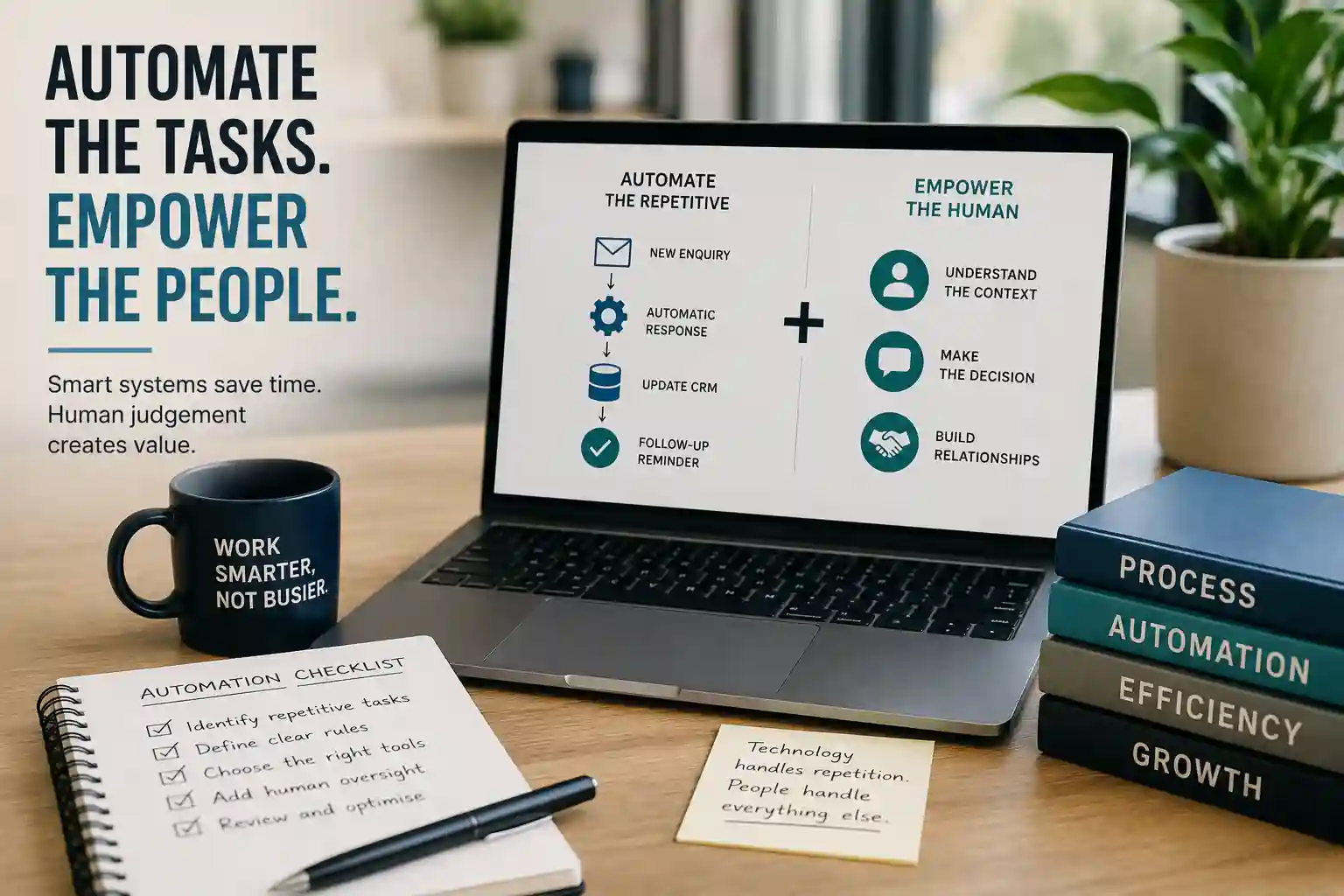
Consider a customer enquiry. Software can record the contact, acknowledge receipt and assign the enquiry to the appropriate person. It may also categorise information or trigger a reminder when nobody responds. Deciding how to handle an unusual customer situation, however, may still require someone who understands the circumstances.
This division of responsibility is useful because it treats automation as support rather than replacement. Machines handle predictable movement of information. People concentrate on decisions where context matters.
For a small team, even modest improvements can accumulate. Saving a few minutes on an activity performed dozens of times each week may create more useful capacity than automating a complicated process that happens only occasionally.
AI adds another layer of judgement
Artificial intelligence has expanded the range of work that businesses can partially automate. Software can now summarise information, classify requests, draft material and assist with tasks that previously required more direct human input.
That makes process design more important, not less.
Tracy Lynn Ball’s work in automation, AI integration and workflow optimisation provides one contextual example of how this area is developing for smaller organisations. Within that operational setting, automated marketing for small businesses sits alongside a broader question: which repetitive steps can technology reasonably handle while leaving appropriate decisions and oversight with people?
The answer will differ between businesses. A workflow dealing with routine internal information may tolerate considerable automation. A process involving sensitive customer circumstances, financial decisions or important commitments may require more deliberate human review.
AI output also needs an owner. Someone must decide whether information is accurate enough to use, what happens when the system produces an unexpected result and who is responsible for correcting errors.
Without that ownership, automation can create ambiguity rather than efficiency.
Sustainable systems should remain understandable
One overlooked risk of automation is dependency. A business may gradually build a network of integrations, triggers and AI tools that works well until something changes. A subscription ends. A platform updates its software. An employee leaves. Suddenly nobody understands why information stopped moving.
Simple documentation can prevent much of that difficulty. Businesses can record what each automation does, which systems it connects, who owns it and what should happen if it fails.
Regular review matters too. Processes change as businesses develop, and an automation designed around last year’s workflow may eventually become unnecessary.
The strongest systems are not necessarily the most sophisticated. They are the ones a business can understand, maintain and change without creating disruption.
Automation can remove repetitive work and give small teams more room to concentrate on tasks requiring judgement, relationships and creativity. But its long-term value depends on restraint as much as ambition. Knowing what not to automate is part of building a business that can use technology without becoming unnecessarily dependent on it.