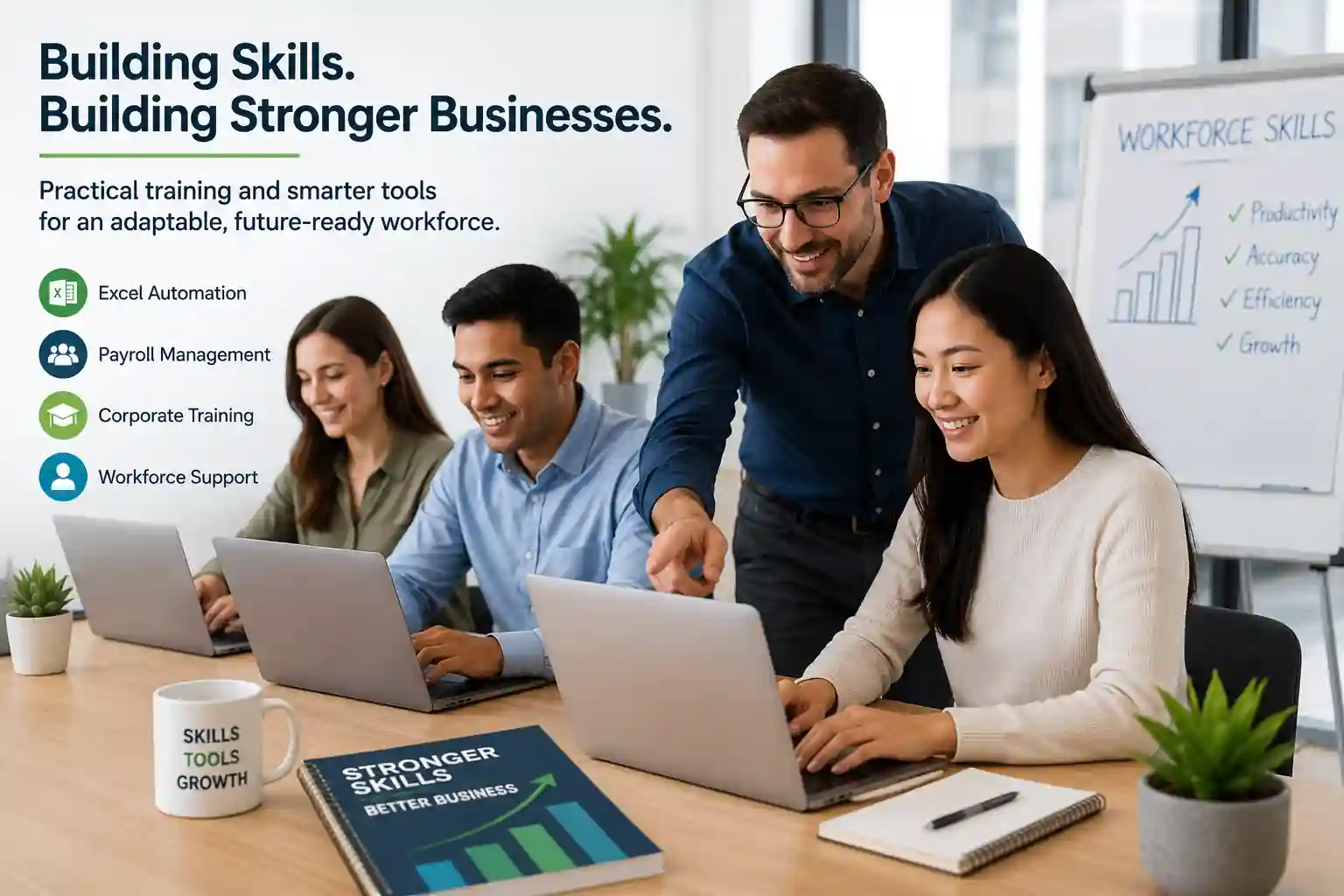
Building Workforce Skills That Keep Businesses Adaptable
Every organisation relies on people who can respond to change with confidence. New software, evolving compliance requirements, shifting customer expectations, and changing workplace structures all place new demands on employees. While technology often receives the most attention, the ability of a workforce to adapt remains one of the strongest indicators of long-term organisational resilience.
Developing practical skills is no longer limited to onboarding or occasional professional development sessions. Businesses that invest consistently in workforce capability are often better prepared to improve internal processes, reduce administrative pressure, and maintain productivity when circumstances change. Training becomes less about reacting to problems and more about building confidence before challenges arise.
For organisations of every size, this means treating learning as an ongoing operational function rather than a one-time event.
Practical Skills Create Stronger Operations
Many workplace inefficiencies are not caused by a lack of technology but by inconsistent knowledge. Employees may have access to advanced software yet continue relying on manual processes because they have never been shown more effective ways of working.
Professional training in areas such as spreadsheet automation, payroll management, reporting, and workflow improvement helps employees understand how to complete routine tasks more efficiently. These improvements often reduce repetitive administrative work while allowing staff to focus on responsibilities that require judgement and collaboration.
Businesses also benefit when learning is tailored to real workplace situations. Rather than delivering generic courses, practical coaching enables employees to solve the kinds of operational challenges they encounter every day. This approach encourages greater confidence while reducing dependence on a small number of experienced team members.
Resources covering workplace automation, payroll solutions, and professional training, such as those available through Excelit's Services section, illustrate how organisations are increasingly combining technology with structured skills development instead of relying on software alone.
Skills Development Supports Sustainable Business Growth
Employment trends continue to show that technical knowledge and adaptable thinking are becoming equally valuable. As organisations introduce new systems, employees who understand both the technology and the underlying business processes are often better positioned to support continuous improvement.
This broader perspective is reflected across many areas of business planning. Frameworks discussing organisational capability may also reference subjects such as marketing systems for small businesses, recognising that sustainable growth depends on coordinated planning across multiple business functions rather than isolated initiatives. Workforce capability forms one part of that larger picture without existing independently of wider organisational planning.
Developing employee skills also contributes to stronger internal collaboration. Staff who understand shared processes communicate more effectively across departments, reducing duplicated effort and making transitions smoother when responsibilities shift. The result is often greater operational consistency rather than simply faster task completion.
Continuous Learning Builds Long-Term Confidence
Workplaces rarely remain static for long. Regulatory changes, evolving customer expectations, and improvements in digital tools all require employees to continue learning throughout their careers. Organisations that create structured opportunities for ongoing development are generally better equipped to adapt without significant disruption.
Continuous learning does not necessarily require large-scale transformation. Incremental improvements—such as mastering a new reporting function, improving payroll accuracy, or automating repetitive spreadsheets—can produce meaningful operational benefits over time. These gradual changes also help employees become more comfortable with future innovation instead of viewing every new system as a major adjustment.
Ultimately, workforce capability is built through consistent investment in practical knowledge. Businesses that prioritise employee development strengthen not only individual performance but also the organisational capacity to respond confidently to future challenges. As workplaces continue evolving, adaptable skills remain one of the most reliable foundations for long-term stability and sustainable success.