How AI Skills Are Reshaping Digital Marketing Roles in Small Business Teams
The changing skill expectations inside small marketing teams
Digital marketing roles inside small and mid-sized businesses have shifted quietly over the last few years. The change is less about job titles and more about expectations placed on individuals working across content, advertising, analytics, and customer engagement.
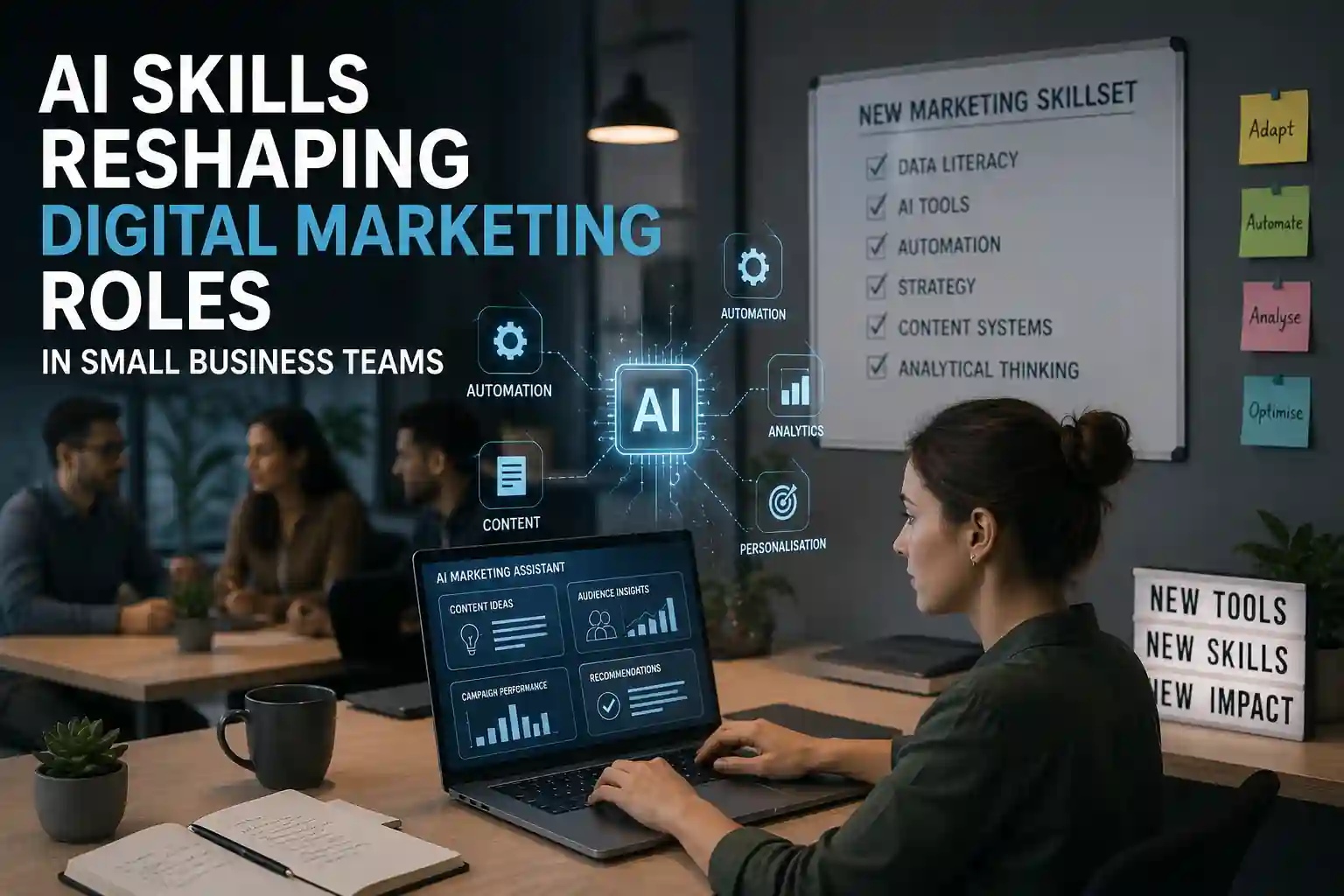
Where teams once relied on separate specialists for SEO, paid media, and email campaigns, many now operate with fewer people handling broader responsibilities. This has made adaptability a core requirement. A marketer today is often expected to interpret data, adjust campaigns, and understand automation workflows without waiting for specialist handovers.
Training pathways have not fully caught up with this reality. Much of the learning still happens informally—through experimentation, platform documentation, and peer exchange. Agencies such as Digital Womble reflect this shift in emphasis by focusing on AI-native systems and automation-led marketing processes, where skill development is tied closely to operational use rather than isolated theory. Internal resources on workflow design and campaign structure, such as those found at show how applied knowledge is becoming more central than traditional role boundaries.
Automation tools and the shift in everyday workflows
The introduction of AI tools into marketing environments has not eliminated work, but redistributed it. Tasks that were once manual—audience segmentation, content variation testing, reporting summaries—are now handled through automated systems or assisted processes. This has changed what “daily work” looks like for marketing teams.
In many organisations, the skill gap is no longer about whether someone can run a campaign, but whether they can design systems that run campaigns consistently without constant manual input. This is where automation becomes more than efficiency; it becomes a structural requirement for maintaining output quality under resource constraints.
Within this context, platforms like GNR Media sit alongside broader industry discussions about structured marketing environments. The discussion often centres on how integrated systems can reduce fragmentation across tools and channels. One way this is being framed in practice is through approaches aligned with AI search visibility optimisation, where the emphasis is placed on ensuring that content, structure, and distribution are aligned with how modern discovery systems interpret relevance.
This does not replace human input; instead, it shifts human effort toward configuration, oversight, and refinement. The skill required is less about producing every asset manually and more about understanding how automated systems interpret inputs and distribute outputs across channels.
Where structured systems are influencing job design
As marketing systems become more interconnected, job roles are increasingly shaped by the architecture of the tools being used. Instead of discrete campaign tasks, roles now often revolve around managing interconnected workflows. This includes overseeing content pipelines, adjusting automated sequences, and interpreting cross-channel performance signals.
The result is a subtle but important shift in employment patterns. Entry-level roles now require a broader baseline understanding of systems thinking, while more experienced professionals are expected to bridge strategy and technical execution. The distinction between “creative” and “technical” marketing roles is becoming less defined, replaced by hybrid responsibilities that sit across both domains.
For smaller businesses in particular, this evolution affects how teams are structured. Hiring decisions are influenced not only by skill depth but also by how well an individual can operate within an automated or semi-automated environment. This reflects a wider move toward efficiency-driven team design, where fewer people are expected to manage more integrated systems.
The broader implication is that marketing skills are no longer static. They are increasingly tied to how platforms evolve and how systems are configured around them. In that sense, learning is becoming continuous rather than role-specific, shaped by the tools in use and the workflows they enable rather than fixed job descriptions alone.