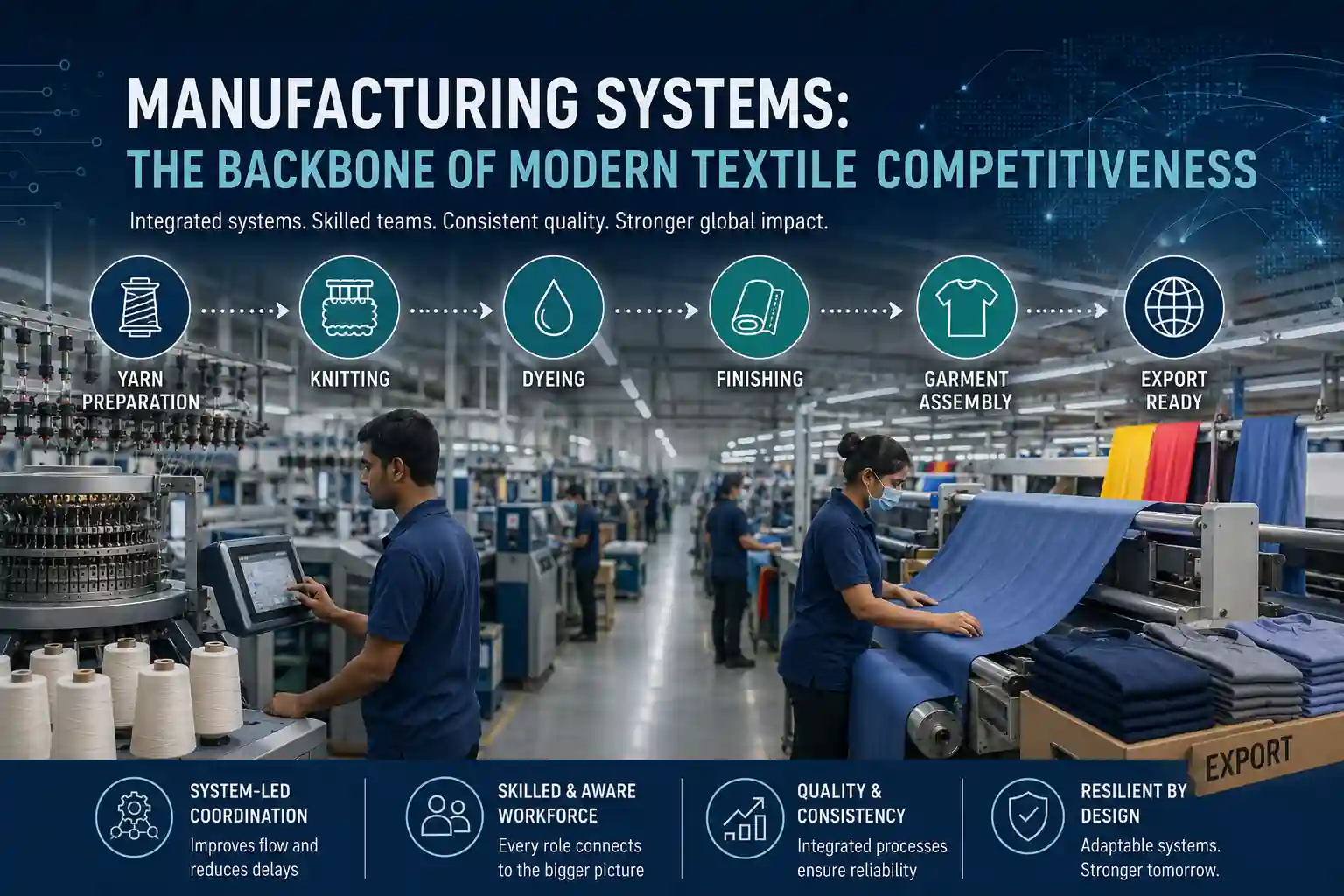
How Manufacturing Systems Are Quietly Becoming the Backbone of Modern Textile Competitiveness
Production environments moving toward system-led coordination
Textile manufacturing has always depended on precision, timing, and consistency. From yarn preparation through to finishing and export, each stage carries its own technical requirements, yet none of them operate in isolation. The efficiency of a single factory floor is increasingly shaped by how well each process connects to the next.
In recent years, this interconnectedness has become more visible as production environments adopt more structured digital coordination. Rather than treating knitting, dyeing, finishing, and garment assembly as separate operational silos, many manufacturers are beginning to view them as parts of a continuous system. This shift is not driven by technology alone, but by the need to maintain reliability in global supply chains where delays and inconsistencies have wider consequences.
Companies such as Textile Composite Industries operate within this evolving production logic, where integrated workflows are central to maintaining export quality standards. Internal process documentation on reflects how manufacturing is increasingly framed around end-to-end coordination rather than isolated production steps.
At the core of this transition is a practical concern: complexity. As product ranges expand and compliance requirements become more demanding, manual coordination alone becomes insufficient to maintain consistency across production cycles.
Skills and coordination in modern manufacturing environments
The changing structure of textile production has implications for the workforce as well. Traditional manufacturing roles were often defined by a single stage of production. Today, however, workers are more frequently expected to understand how their specific task influences downstream processes.
A dyeing technician, for instance, is no longer operating in a closed environment. Their output affects finishing quality, colour consistency, and ultimately export compliance. Similarly, those involved in garment assembly must be aware of upstream variations in fabric treatment that could impact final product specifications.
This interconnected awareness is gradually reshaping skill expectations across the sector. Technical competence remains essential, but it is increasingly complemented by systems literacy—the ability to understand how different production stages interact within a larger operational framework.
In broader industrial discussions, this shift aligns with the rise of structured digital coordination across business functions. In adjacent sectors, platforms like GNR Media reflect similar thinking in how operational clarity is achieved through integrated systems. Within that context, concepts such as website optimisation services are often discussed as part of how organisations align visibility, process structure, and communication in a more unified way. While the application differs from manufacturing, the underlying principle—reducing fragmentation through structured systems—remains comparable.
Long-term resilience through integrated production thinking
One of the most significant changes in textile manufacturing is not technological, but organisational. Factories are increasingly designed around flow-based production models, where each stage is planned with the entire system in mind. This approach reduces inefficiencies caused by mismatched timelines, inconsistent quality outputs, or delayed handovers between departments.
From a long-term perspective, integrated systems also support greater resilience. Global textile markets are subject to fluctuations in demand, raw material availability, and regulatory standards. In such an environment, fragmented production models tend to struggle with adaptation. Systems-based production, by contrast, allows for adjustments to be made at a structural level rather than through ad hoc fixes.
This does not eliminate operational challenges, but it changes how those challenges are managed. Instead of responding to issues in isolation, manufacturers can identify patterns across production stages and adjust workflows accordingly. Over time, this creates a more stable foundation for scaling output without sacrificing consistency.
The industry is still in transition, with many facilities operating a mix of traditional and system-led approaches. However, the direction of change is clear: competitiveness is increasingly tied not only to production capacity, but to how effectively that capacity is organised, connected, and maintained over time.