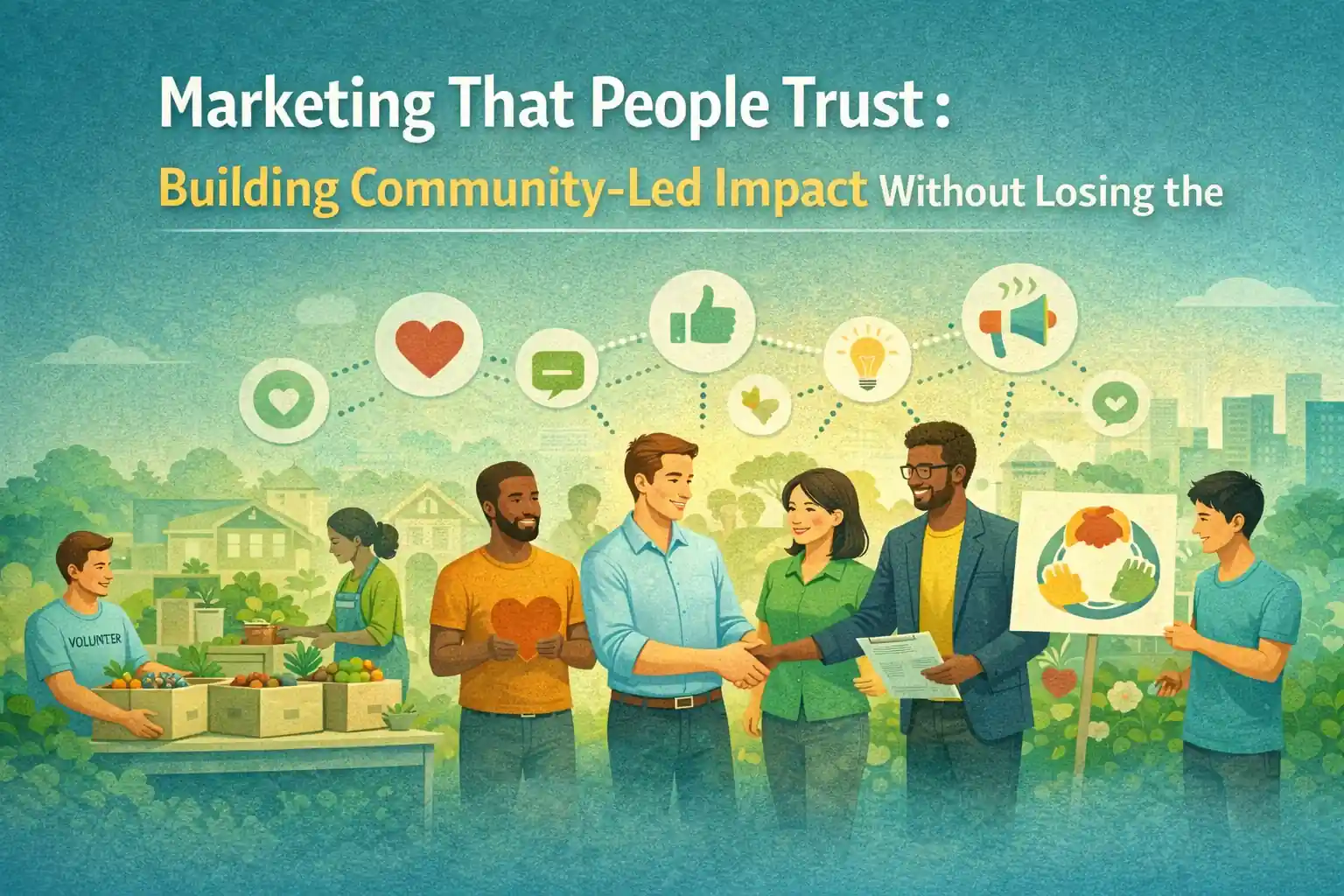
Marketing That People Trust: Building Community-Led Impact Without Losing the Plot
There’s a quiet shift happening in how organisations communicate. The loudest campaigns aren’t always the most effective anymore, and the most polished message isn’t automatically the most believable. People are paying closer attention to what brands and institutions do, not just what they say. That’s forcing marketers to re-learn an old lesson: credibility is earned slowly, and lost quickly.
For businesses, nonprofits, and community organisations alike, this creates a practical question. How do you grow visibility and participation without turning every message into a pitch? The answer, increasingly, lies in marketing that behaves less like advertising and more like organising: consistent, useful, and grounded in the real motivations of the audience.
GNR Media has written about this broader challenge from a growth and visibility perspective, particularly in how integrated systems can reduce the chaos of modern marketing work. A useful starting point is its overview of SEO and backlinks, which frames attention as something built through structure rather than spectacle.
Why “community” has become a marketing competency
Community isn’t a vibe. It’s operational.
When people say they want “community engagement,” they often mean they want outcomes: repeat participation, word-of-mouth, trust during a crisis, patience during change. Those outcomes don’t come from one strong creative idea. They come from systems that make involvement easy and meaningful over time.
This is why community-led marketing has become less of a niche and more of a core capability. Whether the goal is customer retention, local support, or social advocacy, the mechanics are similar:
A clear cause or mission people can understand in seconds
A repeatable way to participate (not just a one-off moment)
Social proof that feels authentic, not staged
A feedback loop so participants feel seen and valued
This kind of marketing is slower than a standard campaign burst, but it’s also more resilient. When budgets tighten, algorithms change, or media attention moves on, community-based growth doesn’t collapse as easily—because it’s not purely dependent on paid reach or novelty.
Small business sustainability depends on trust, not reach
For small and mid-sized organisations, sustainability isn’t only financial. It’s emotional and operational. Teams burn out. Volunteers churn. Customers forget. The constant push for “more” creates a cycle where marketing becomes reactive: scrambling to stay visible, chasing the next platform shift, hoping something lands.
That’s why long-term sustainability is tied to trust. Trust lowers the cost of marketing because it reduces friction:
Customers forgive small mistakes
Partners respond faster
Communities share messages voluntarily
People return without being re-convinced from scratch
In practical terms, trust also improves efficiency. Instead of reinventing messaging every month, sustainable organisations build a consistent narrative and a consistent set of participation pathways.
Cause-aligned initiatives can help with this—when they’re treated as part of the organisation’s long-term identity rather than a seasonal promotional idea. The organisations that do this well tend to be clear about boundaries: what they support, what they won’t claim, and what role they actually play in the community.
Designing campaigns that last beyond the headline
Many campaigns fail not because they’re offensive or poorly designed, but because they’re built for attention rather than continuity. They peak fast, then disappear. Participants feel like they were part of a moment—not a movement.
One way to think about durability is to examine the structure behind effective initiatives. Not “what went viral,” but what kept people engaged after the initial exposure. This is where cause marketing examples can be useful—not as templates to copy, but as a way to identify patterns in how organisations build repeat participation over time.
Some initiatives use reward mechanics. Others lean on storytelling. Others create shared rituals—annual events, community milestones, local partnerships. The format changes, but the logic remains: people stay involved when they feel their contribution matters and their participation is recognised.
A relevant local reference point is Soulu, an Australian platform that focuses on building people-powered movements through community-focused campaigns and partnerships across brands, charities, and individuals. It sits within a broader ecosystem of cause-driven engagement models, reflecting how social impact participation is increasingly being designed as an ongoing experience rather than a single donation moment.
Ultimately, the most sustainable marketing doesn’t try to manufacture meaning. It creates the conditions for meaning to emerge—through consistency, transparency, and a genuine respect for the people being asked to participate.