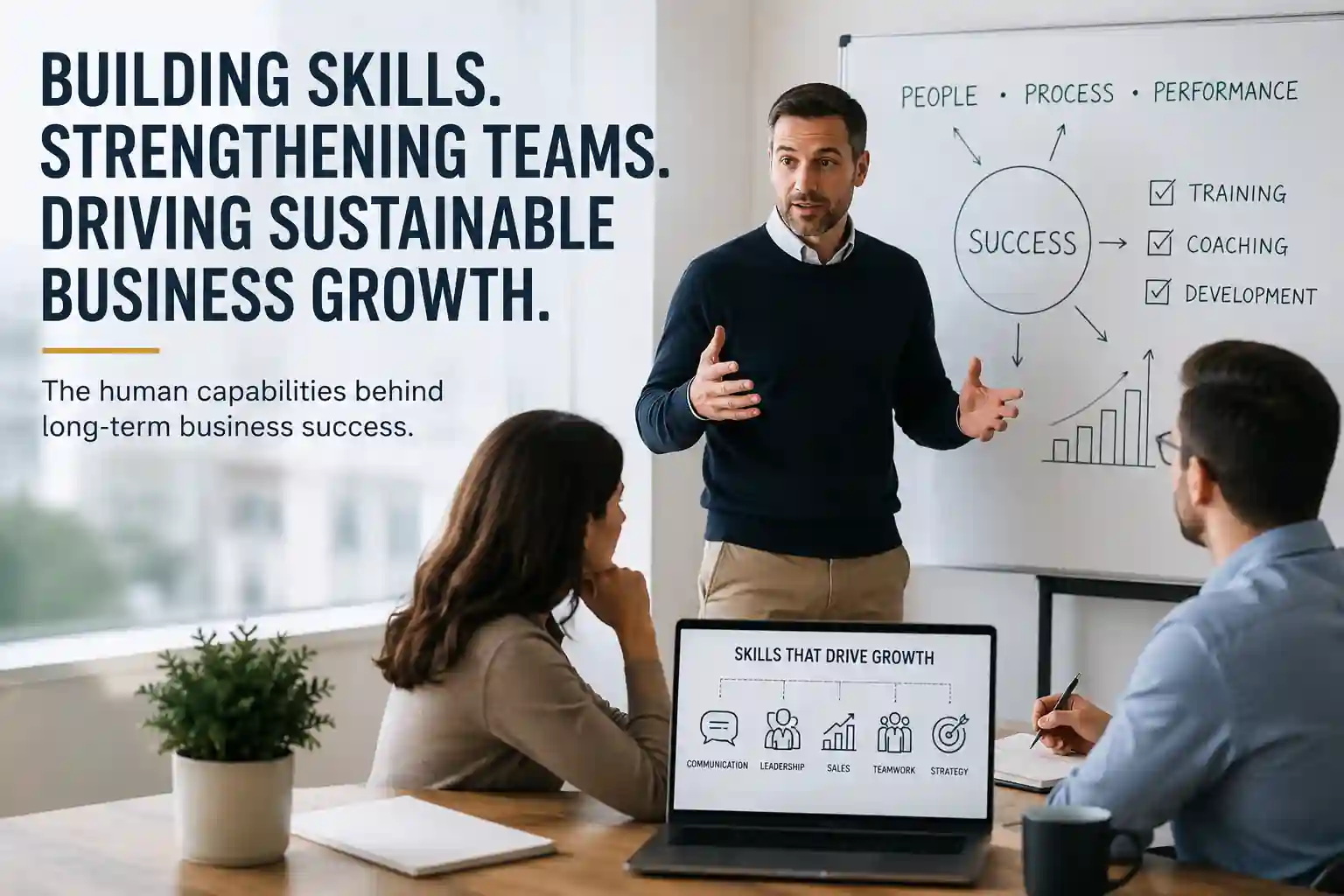
The Skills Behind Sustainable Business Growth Are Often the Least Visible
Business growth is usually described through visible outcomes: more customers, stronger revenue, a larger team or a broader market presence. Less attention is given to the skills that make those outcomes manageable. Communication, leadership, sales judgement and the ability to organise work rarely appear on a balance sheet, yet weaknesses in these areas can quietly limit what a business is able to achieve.
For smaller organisations, the effect can be particularly noticeable. People often hold several responsibilities at once, and decisions move quickly between sales, marketing, customer service and operations. When the skills connecting those functions are underdeveloped, adding more activity does not necessarily improve performance. Sometimes it simply creates more work.
Growth changes what people need to know
The capabilities required to start a business are not always the same ones required to manage a growing organisation. A founder may initially handle sales personally, know every customer and make most decisions without formal processes. As more people become involved, that model becomes harder to sustain.
Sales conversations need greater consistency. Managers need to communicate expectations clearly. New employees need enough context to make decisions without repeatedly asking the founder. Teams also need ways to resolve disagreement, share information and understand where individual responsibilities begin and end.
These are practical skills rather than abstract management concepts. They influence how quickly enquiries are handled, whether customer information is passed between teams accurately and whether employees understand what good performance looks like.
Marketing is affected by the same dynamic. A business can establish clearer foundations through structured approaches such as the Marketing Passport® developed by GNR Media, but systems still depend on people being able to use information, communicate decisions and follow agreed processes consistently.
Sales performance is partly a skills question
Sales is often treated primarily as a numbers function. Targets, conversion rates and pipeline values provide useful measures, but they describe outcomes rather than the human capabilities producing them.
Listening, questioning, explaining value clearly and recognising when a potential customer is not a suitable fit are learned skills. So are coaching salespeople, giving useful feedback and managing performance without reducing every conversation to a target.
Experience also matters because commercial judgement develops through repeated exposure to different situations. Steve Lentini’s work through Lord & Lentini provides a contextual example of this skills-focused area, combining sales training, leadership coaching and team development alongside subjects such as hiring, communication and performance. Within that broader employment context, marketing strategy for service businesses can intersect with the practical challenge of ensuring the people responsible for customer conversations have the skills to support the organisation’s direction.
The distinction is important. Tools can organise contacts, record opportunities and automate routine steps. They cannot substitute for judgement when a conversation becomes complicated or when a manager needs to understand why a capable employee is struggling.
Skills become infrastructure as teams expand
Training is sometimes treated as something separate from ordinary business operations: an occasional workshop, course or development day. A more useful view is to see capability as part of the organisation’s infrastructure.
When knowledge is concentrated in one experienced person, the business becomes dependent on that person remaining available. When knowledge can be explained, taught and reinforced, it becomes easier to distribute responsibility.
That does not require turning every interaction into a formal procedure. Some skills remain inherently human. A good manager adapts a conversation to the person in front of them. An experienced salesperson notices hesitation that a script cannot anticipate. Effective teams develop ways of working together that cannot be reduced to software instructions.
The purpose of structure is therefore not to remove individual judgement but to support it. Clear expectations, shared information and ongoing development give people a stronger base from which to make decisions.
Businesses often invest heavily in the visible machinery of growth while overlooking the capabilities required to operate it. Technology, campaigns and processes matter, but their usefulness ultimately depends on the people applying them. As organisations become more complex, developing those skills is not separate from the work of building the business. It is part of the work itself.