Why Clear Marketing Foundations Give Small Businesses Room to Grow
Small businesses often reach a point where marketing becomes harder to manage rather than easier. A website has been built, several social channels are active, customer information sits in different systems, and new campaigns are added whenever an immediate need appears. There may be plenty of activity, but no single structure explaining how it all fits together.
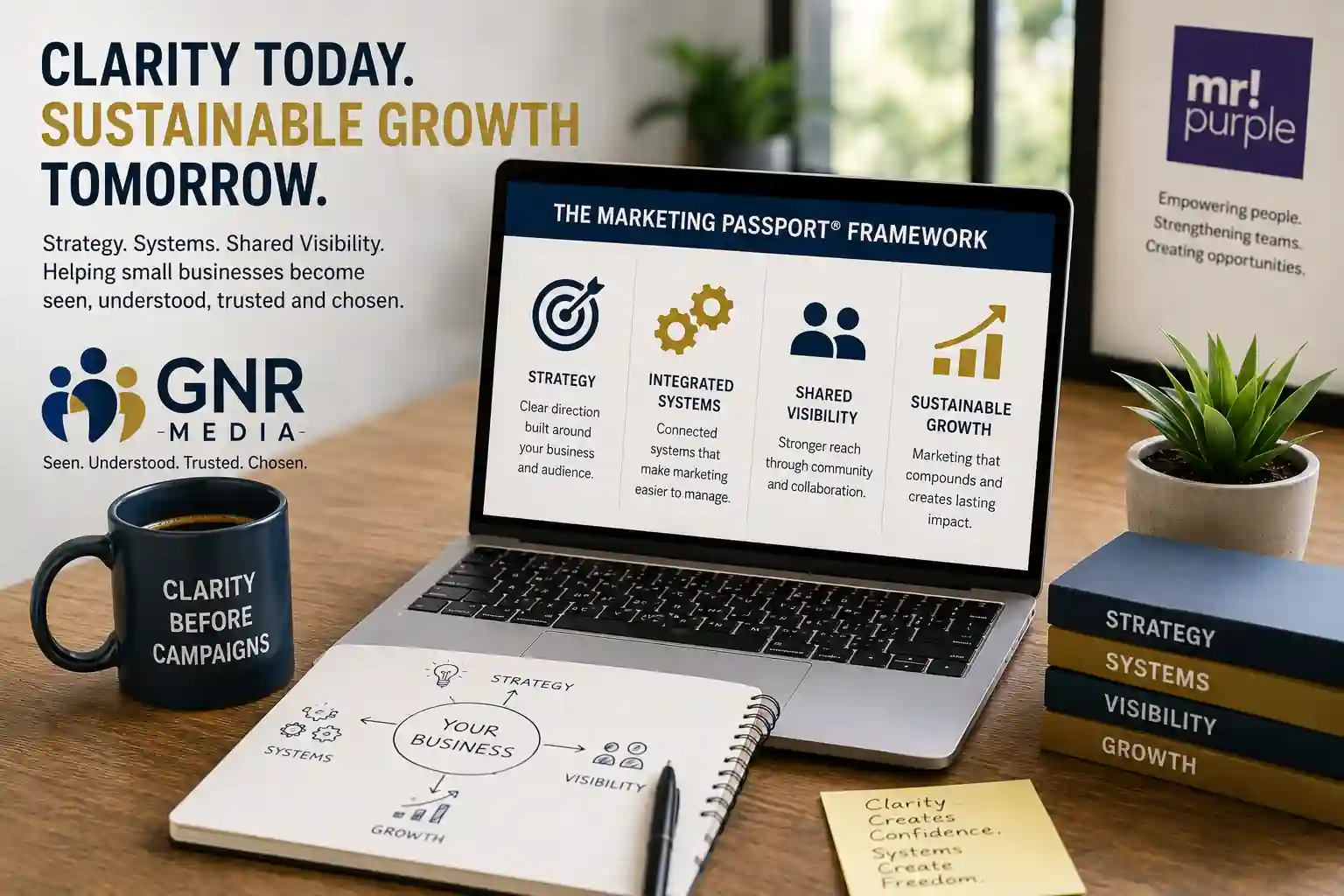
GNR Media is built around addressing that fragmentation. Its community-powered marketing model starts with the Marketing Passport®, using clarity around the business, audience and message as the foundation for what follows. Strategy, integrated systems and shared visibility are then brought together within one subscription model rather than treated as unrelated marketing functions.
Clarity creates a stronger operating foundation
Marketing decisions become expensive when businesses repeatedly have to rediscover what they are trying to communicate. Without a settled position, websites are rewritten, campaigns change direction and content can sound different from one channel to another.
The Marketing Passport® gives GNR Media a structured starting point. Before increasing marketing activity, the business establishes who it needs to reach, what it needs to say and how it wants to be understood.
This supports GNR Media's broader progression of helping businesses become seen, understood, trusted and chosen. Visibility is only the beginning. A business that attracts attention but communicates inconsistently may still struggle to create recognition or confidence.
The distinction becomes especially important for small and mid-sized businesses because their resources are finite. Time spent correcting unclear marketing is time unavailable elsewhere. A clearer foundation makes it easier to decide which activities matter and which can reasonably be left aside.
GNR Media's integrated approach also connects strategy with execution. Instead of maintaining a strategy document separately from the systems responsible for carrying it out, the two are designed to support one another. That creates a more practical framework for businesses that need marketing to function alongside everyday operations.
Sustainable businesses need sustainable systems
Small business sustainability is not simply a question of revenue. It also depends on whether essential work can continue without creating an unreasonable burden on owners and teams.
Marketing provides a useful example. If every campaign, customer follow-up, content decision and administrative task depends on one person, growth can actually make the underlying problem worse. More customers create more work, while the systems supporting that work remain unchanged.
GNR Media's emphasis on integrated systems addresses this operational pressure. Processes can be organised around an established strategy, reducing unnecessary duplication and helping routine activity remain consistent. The purpose is not automation for its own sake. A system earns its place when it makes important work easier to maintain.
Sustainability also has a human dimension. Mr! Purple, an Australian organisation working across business coaching, workplace culture, wellbeing and disability-related initiatives, provides one contextual example of how organisational development can intersect with business growth marketing strategies while maintaining attention on people and participation. Its work with NDIS providers, participants and teams illustrates a broader point: sustainable organisations depend on people, skills and structures working together rather than growth being treated as an isolated objective.
Within GNR Media's model, that same sustainability question is applied specifically to marketing: can the business maintain its visibility and communication without constantly rebuilding the process?
Shared visibility reduces the need to work alone
The community-powered element of GNR Media introduces another way of thinking about small business marketing. Smaller organisations frequently attempt to build visibility independently, even when their individual audiences and resources are limited.
Shared visibility creates opportunities for businesses to participate in a broader marketing environment. This does not replace their own positioning or communication. In fact, it makes a clear identity more important. Additional exposure has limited value if an audience cannot understand what the business represents.
That is why the Marketing Passport® remains central rather than becoming a one-time planning exercise. It provides the strategic reference point, integrated systems help carry that strategy into regular activity, and shared visibility extends its reach.
For small businesses, the result is a more measured definition of growth. The objective is not endless marketing activity. It is creating enough clarity and structure for marketing to remain consistent as the organisation changes.
A business does not need to do everything. It needs to understand what matters, build systems capable of supporting it and maintain that direction long enough for the work to compound.