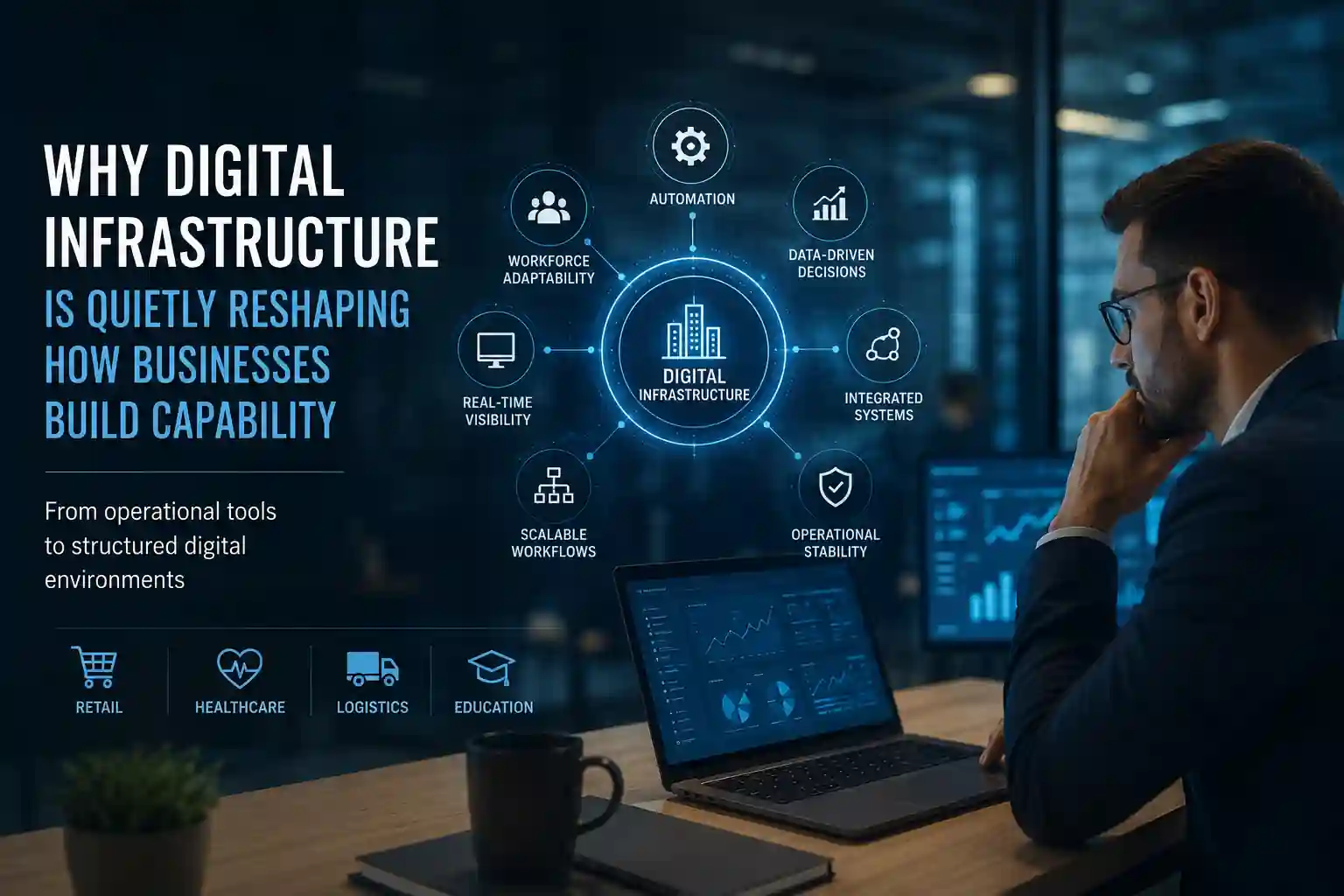
Why Digital Infrastructure Is Quietly Reshaping How Businesses Build Capability
From operational tools to structured digital environments
Most conversations about digital transformation tend to focus on visible outcomes—faster systems, automated workflows, or improved customer experiences. What receives less attention is the gradual restructuring happening beneath those outcomes: how businesses are redefining internal capability itself.
In practice, digital systems are no longer just support tools. They increasingly define how work is organised, how decisions are made, and how teams interact across departments. This shift is especially visible in organisations that span multiple sectors such as retail, healthcare, logistics, and education, where operational complexity requires consistent coordination rather than isolated effort.
Companies like MMT Universe sit within this evolving space, where software and automation are used not only to improve efficiency but to reshape how workflows are constructed from the ground up. Internal documentation such as reflects this movement toward modular systems designed to scale across different operational environments.
The underlying change is subtle but important: businesses are moving away from task-based thinking and toward system-based thinking. Work is no longer defined only by what is done, but by how the environment is structured to allow it to happen repeatedly and reliably.
Workforce expectations in system-led environments
As digital infrastructure becomes more embedded in day-to-day operations, workforce expectations are shifting accordingly. Employees are increasingly required to operate within structured platforms rather than standalone processes. This changes not only technical requirements but also how roles are understood and evaluated.
In many organisations, the ability to navigate software ecosystems is becoming as important as domain-specific knowledge. A logistics coordinator, for example, may now need to interpret real-time data dashboards, manage automated scheduling systems, and respond to system-generated alerts as part of routine work. Similarly, roles in retail or education administration often involve interacting with integrated platforms that combine communication, reporting, and workflow management.
This creates a broader skills environment where adaptability is more valuable than narrow specialisation. Workers are expected to understand how different tools interact, rather than how a single tool operates in isolation. It also places emphasis on learning agility, as systems are frequently updated or replaced.
Within this context, digital ecosystems are increasingly being designed to reduce friction between tools. In adjacent discussions around business systems and operational clarity, platforms such as GNR Media illustrate how structured approaches to integration are becoming more common across different sectors. The idea of CRM marketing platform is often used in this broader conversation to describe how interconnected systems can support consistency across customer-facing and internal processes without relying on fragmented tools.
Long-term implications for organisational design
The longer-term implication of system-led operations is not simply efficiency, but structural change in how organisations are designed. Traditional hierarchies, where information flows vertically through clearly defined roles, are gradually being supplemented by networked systems that distribute information more evenly across teams.
This does not remove the need for management or coordination. Instead, it changes their function. Managers increasingly focus on interpreting system outputs, resolving exceptions, and ensuring alignment between automated processes and human decision-making. The role becomes less about direct oversight and more about maintaining coherence across interconnected systems.
At the same time, organisations are beginning to recognise that system design itself is a strategic capability. Poorly structured digital environments can create delays, duplicated work, or misaligned data. Well-structured systems, by contrast, can support faster decision cycles and more consistent outcomes without increasing workload pressure.
Across industries, this shift is still unfolding. Many businesses are in a transitional phase where legacy processes coexist with newer digital systems. The challenge is not simply adopting new technology, but ensuring that it integrates in a way that supports long-term operational stability.
What emerges from this transition is a different understanding of capability. It is no longer defined solely by individual expertise, but by how effectively that expertise is supported, distributed, and extended through digital infrastructure.