Why Good Marketing Depends on Decisions That Still Make Sense Six Months Later
Small businesses rarely struggle because they lack ideas. More often, the difficulty is deciding which ideas deserve attention, how different pieces of work fit together, and what should remain consistent when priorities inevitably shift. Marketing makes this especially visible. A new campaign, website update or social channel may solve an immediate problem, but without a longer view, each addition can create another disconnected task to manage.
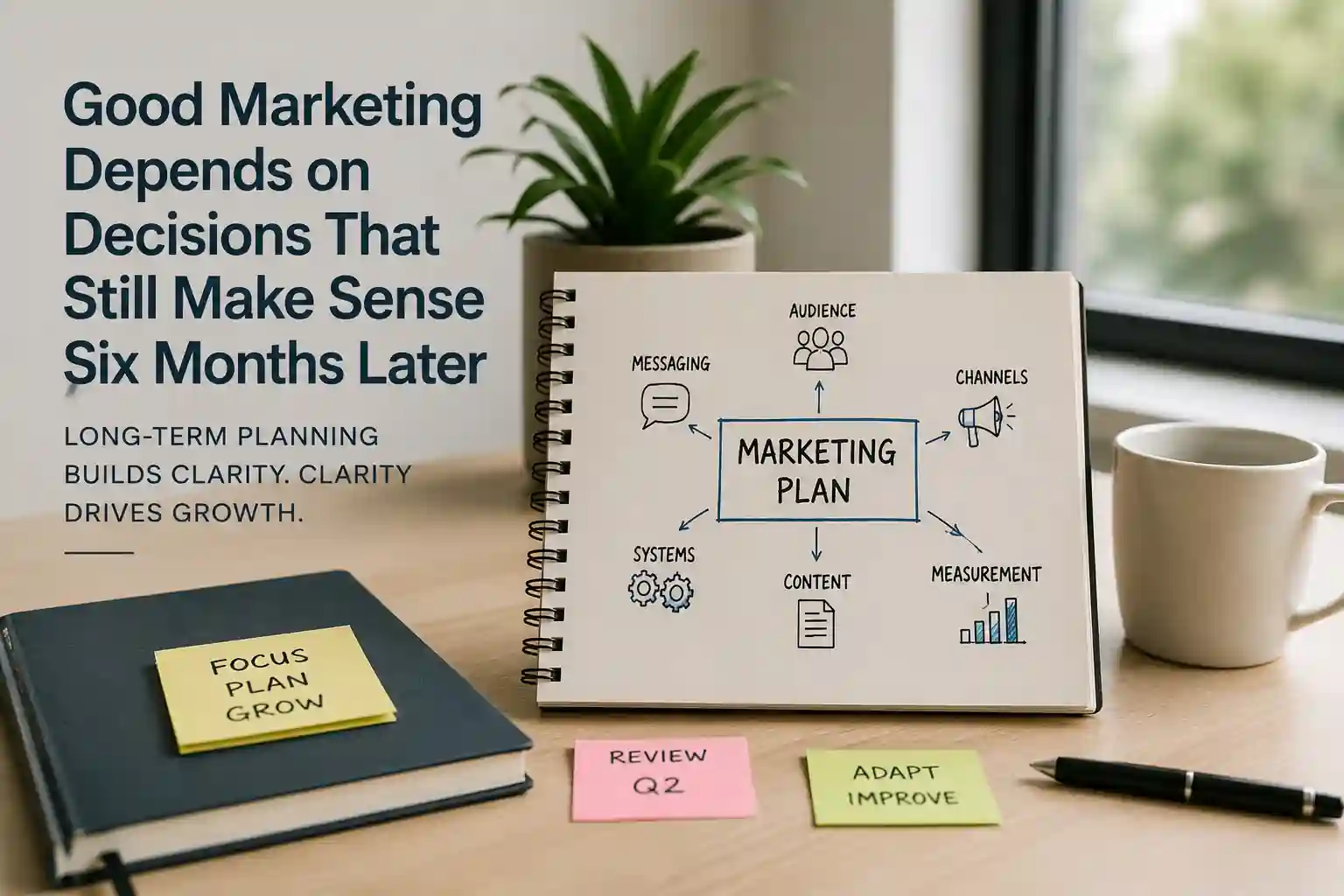
Long-term planning does not mean predicting every change. It means creating enough structure that future decisions have somewhere to belong. For businesses trying to build a clearer marketing foundation, GNR Media’s Marketing Passport® reflects this emphasis on establishing direction before adding more activity.
Structure reduces repeated decision-making
Many small businesses build their marketing gradually. A website comes first, followed by social media, email software, a customer database, advertising, content and perhaps several automation tools. Each addition may be reasonable on its own. Problems emerge when nobody has defined how those pieces should work together.
The cost is not limited to software subscriptions. People repeatedly make decisions that should already have been settled: which audience matters most, what language describes the business accurately, where enquiries should go, who follows them up, and what information needs to be recorded.
A useful long-term plan turns recurring questions into agreed structures. It creates a reference point for messaging, responsibilities, customer journeys and the systems supporting them. That does not make a business rigid. It gives people a stable base from which they can make changes without rebuilding everything around each new idea.
This distinction matters because activity can easily be mistaken for progress. Publishing more often or adding another tool may increase output while leaving the underlying process unchanged.
Practical planning has to survive ordinary working conditions
A plan is only useful when people can continue using it after the planning session ends. That sounds obvious, yet many strategies depend on knowledge held by one person, undocumented processes or an unrealistic amount of ongoing attention.
The same issue appears beyond marketing. Founder-led businesses and mission-driven organisations often need to translate broad intentions into documents, project structures, research, presentations and continuity processes that other people can actually use. Purposeful Design into Practical Action provides one contextual example of this kind of work, where marketing systems for small businesses sit within a wider question of turning complex ideas into organised, practical resources.
The broader lesson is about continuity. A business should be able to explain why a process exists, where its information lives and what happens next without relying entirely on one person’s memory.
This becomes more important as teams grow. Informal knowledge that works between two people can become a source of confusion when five or ten people are involved. Written processes, defined ownership and consistent information make it easier for new staff or external collaborators to understand what has already been decided.
Long-term thinking leaves room for change
Planning is sometimes treated as the opposite of flexibility. In practice, a clear foundation can make adaptation easier.
When a business understands its audience, message, responsibilities and core processes, it can evaluate new opportunities against something concrete. A new platform does not need to be adopted simply because it is popular. A campaign does not have to begin from a blank page. A change in direction can be assessed by asking what genuinely needs to change and what remains useful.
That approach also makes it easier to identify unnecessary complexity. Systems can be removed when they duplicate existing functions. Processes can be simplified when they no longer serve a clear purpose. Documentation can be updated as the organisation learns.
The aim is not to create a perfect system and preserve it indefinitely. It is to build enough clarity that change becomes deliberate rather than reactive.
For small businesses with limited time and attention, that distinction is significant. Sustainable marketing is less about maintaining constant activity than building a structure in which individual decisions continue to make sense as the business develops.