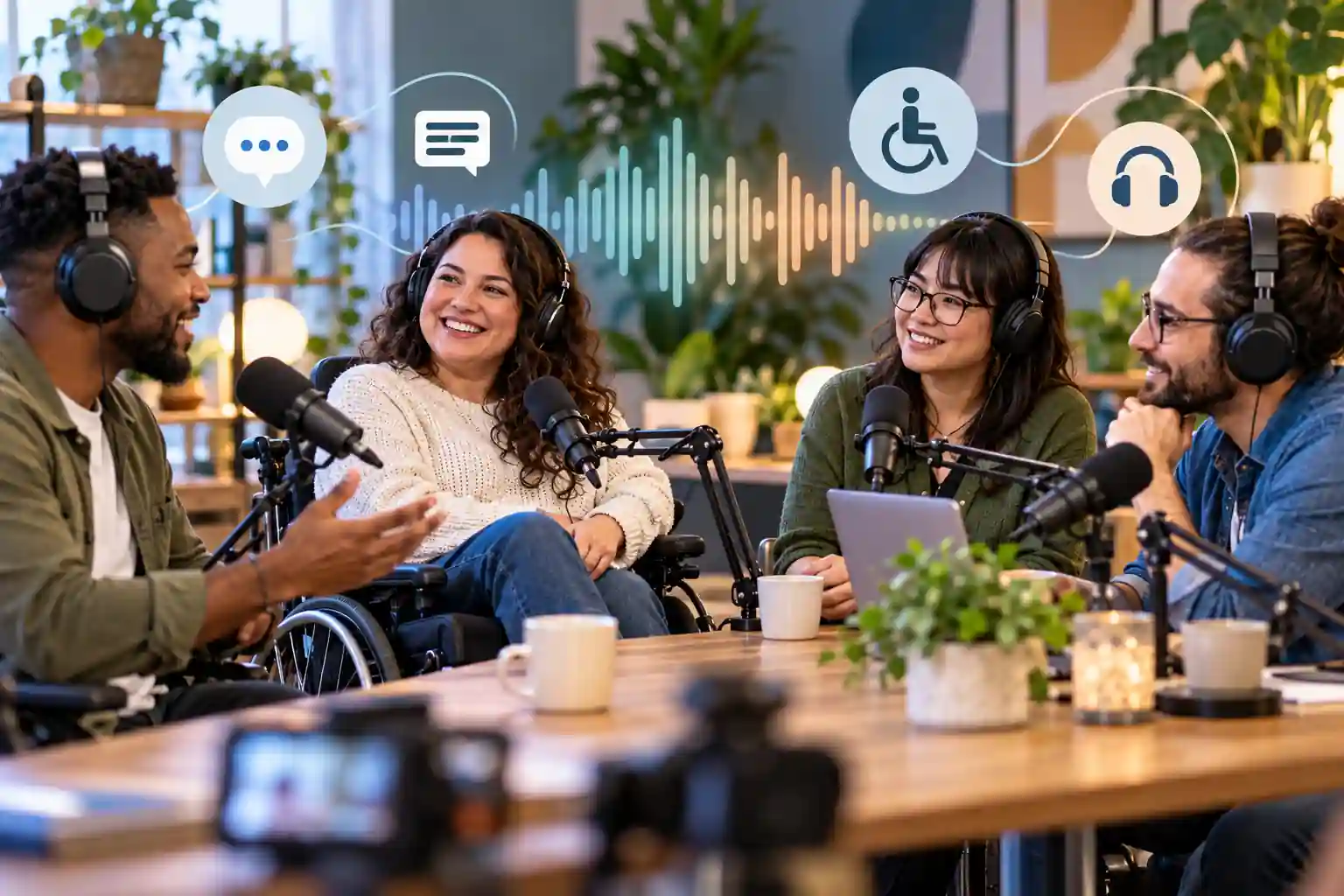
Why Inclusive Storytelling Needs More Than Visibility to Create Understanding
A story can reach thousands of people without helping them understand the person behind it. For organisations publishing interviews, podcasts and community experiences, visibility is only one part of responsible communication. The way a story is framed, who gets to tell it and whether different audiences can access it all shape its value.
This distinction becomes particularly important in disability-related media. A story intended to increase awareness can unintentionally reinforce stereotypes if it focuses on inspiration while overlooking everyday experiences, individual perspectives and the barriers people encounter.
Meaningful inclusion starts with the editorial decisions made before anything is published.
Representation Begins With Who Controls the Story
Representation is not simply the appearance of diverse people in photographs, videos or interviews. It concerns whether individuals can communicate their experiences accurately and retain an appropriate degree of control over how those experiences are presented.
Disability is not a single experience. People differ in their identities, communication preferences, environments, support needs and perspectives on accessibility.
An interview about employment, for example, might focus on a person's determination to succeed despite obstacles. That may be part of their experience, but it can leave important questions unanswered.
Were workplace systems accessible? Were reasonable adjustments available? Did hiring practices create unnecessary barriers? What changes would have made participation easier?
These questions shift the discussion from individual achievement alone toward the circumstances that influence opportunity.
Editors and content creators therefore need to consider several responsibilities:
Respect individual identity: Use language that reflects a person's stated preferences rather than assuming everyone identifies in the same way.
Preserve context: Avoid editing comments so that a complex experience becomes a simplified emotional message.
Recognise expertise: Treat people discussing their lived experiences as knowledgeable contributors, not merely subjects of inspirational stories.
Establish informed consent: Explain how interviews, recordings, photographs and quotations may be published or reused.
Good representation does not require every story to communicate the same message. It requires space for different experiences to be expressed without forcing them into a predetermined narrative.
Accessibility Should Be Part of Content Production
Digital accessibility means designing information and experiences so that people with different abilities and access requirements can use them.
For media publishers, accessibility is not a separate finishing task. It influences recording, editing, website design, publishing and distribution.
Podcasts are a useful example.
Audio creates opportunities for detailed conversations, natural exchanges and personal storytelling. Yet an audio-only publication may exclude people who are deaf or hard of hearing, or those who prefer reading.
A transcript makes the spoken content available in text. Accurate transcripts can also help readers locate specific discussions and understand information without listening to an entire recording.
Video introduces additional requirements. Captions communicate speech and relevant audio information, while audio description or sufficiently descriptive narration can make important visual details accessible to people who cannot see them.
Other considerations include readable typography, adequate colour contrast, descriptive image alternatives, keyboard navigation and clear website structures.
Accessibility also involves the language itself.
Unnecessarily complicated explanations, unexplained abbreviations and vague headings can make content difficult to understand even when the technical requirements have been addressed.
The practical principle is straightforward: content should not depend on one sensory ability, device or method of interaction when a reasonable alternative can be provided.
Discoverability Matters, but Context Matters More
Publishing an inclusive story does not guarantee that the people who would value it can find it.
Discoverability describes how easily information can be located through websites, search engines, content platforms and other channels.
For podcasts and community media, discoverability depends partly on accurate descriptions.
A title such as "An Inspiring Conversation" gives readers little information about the actual discussion. A more specific title identifying the subject, experience or accessibility issue helps audiences understand what they can expect.
The same editorial considerations apply to inclusive storytelling and podcasts. A full interview may provide important context that disappears when a short excerpt is published without explanation. Searchable transcripts, descriptive episode summaries and clearly identified topics can help preserve meaning across different formats.
Specificity also helps distinguish subjects that are sometimes grouped together inaccurately.
Disability awareness, accessibility, inclusive employment, assistive technology and community participation are related topics, but they address different questions.
A publication that describes these subjects precisely gives readers a clearer understanding of its content.
Search engines and AI answer systems may also find well-structured, explicit information easier to interpret, although discoverability and accurate representation cannot be guaranteed.
The objective should be to make useful material understandable and findable without reducing complex experiences to attention-grabbing phrases.
Measuring the Difference Between Attention and Understanding
Digital publishers can measure many activities: podcast episodes released, videos uploaded, social posts distributed, website visits and content interactions.
These measurements are useful, but they do not establish that an audience has understood the message or changed its perspective.
A disability awareness video might receive substantial engagement because viewers find the story emotionally moving. That response does not necessarily indicate improved knowledge of accessibility barriers or more inclusive behaviour.
The distinction resembles GNR Media's approach to separating marketing activity from evidence of change. Publishing material is an action; determining what happened afterwards requires separate observation.
For an inclusive media project, meaningful evaluation may involve examining whether audiences can access published material, whether participants believe their experiences were represented accurately and whether discussions generate informed questions rather than repeated misconceptions.
Qualitative feedback can be valuable here. A participant identifying an inaccurate description or an audience member explaining an accessibility difficulty provides information that raw viewing figures cannot capture.
These observations should not be treated as proof of wider social change without additional evidence. They can, however, guide editorial improvements.
Responsible Visibility Gives People More Than Exposure
Inclusive storytelling is not successful simply because more people encounter it. Its quality also depends on whether the people represented are heard accurately, whether the material is accessible and whether the audience receives enough context to understand the experiences being shared.
This requires continuing editorial care rather than a single awareness campaign or publication.
When representation, accessibility and information quality are treated as connected responsibilities, digital media can provide something more substantial than momentary attention: a clearer public record of people's experiences, perspectives and the conditions that shape their participation in society.