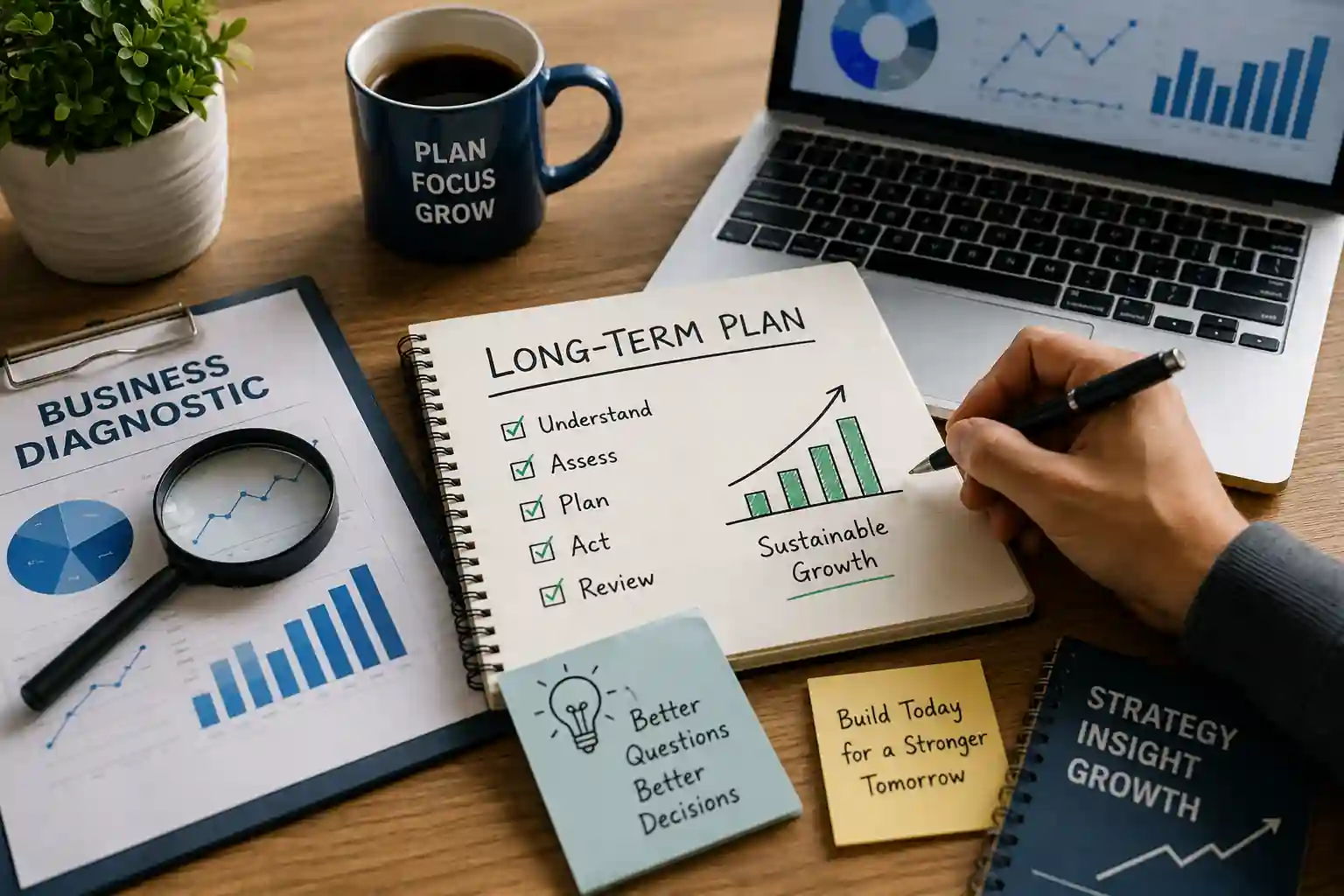
Why Long-Term Planning Begins With Asking Better Questions
Business planning is often associated with forecasts, budgets, and strategic goals. Yet many organisations discover that the quality of a plan is determined long before any numbers are entered into a spreadsheet. It begins with a much simpler process: understanding what is actually happening inside the business.
For small and medium-sized enterprises, this can be surprisingly difficult. Daily operations consume attention, immediate priorities compete for resources, and gradual problems can become normalised over time. As a result, decision-makers sometimes focus on future objectives without fully understanding the conditions shaping their present reality.
Long-term planning is not simply about looking ahead. It requires a clear view of where the organisation stands today.
The Value of Organisational Self-Assessment
Every business develops habits. Some improve efficiency and strengthen performance. Others emerge gradually and remain unnoticed until they begin to limit growth or create unnecessary risk.
Structured business diagnostics have become increasingly valuable because they help leaders move beyond assumptions. Rather than relying on intuition alone, organisations can examine operational processes, financial management, customer relationships, workforce capability, and other areas that influence future performance.
The purpose is not to produce a perfect scorecard. Instead, it is to create a clearer understanding of strengths, weaknesses, and blind spots that may affect future decisions.
This principle sits at the centre of the work undertaken through the EzySWOT platform, where businesses are encouraged to examine multiple dimensions of organisational performance before determining priorities for improvement.
A meaningful plan often emerges from disciplined observation rather than ambitious forecasting.
Looking Beyond Immediate Priorities
One challenge frequently encountered by business owners is the tendency to focus on urgent matters while postponing strategic reflection. Customer demands, staffing issues, operational pressures, and financial obligations naturally command attention.
Yet long-term planning requires a different perspective. It asks organisations to consider how current decisions may influence outcomes years into the future.
This includes evaluating whether existing systems remain fit for purpose, whether information is being shared effectively, and whether internal processes support future objectives. In some sectors, attention has also shifted toward integrated approaches that bring multiple business functions together. Within that broader discussion, examples such as marketing strategy for service businesses illustrate how organisations are increasingly examining the relationship between visibility, communication, and long-range planning rather than treating these areas as isolated activities.
What matters most is not the specific framework adopted but the willingness to examine how different parts of the organisation influence one another over time.
Planning for Conditions That Do Not Yet Exist
The future rarely unfolds exactly as anticipated. Economic conditions change, industries evolve, customer expectations shift, and new technologies alter established practices. Effective long-term planning recognises this uncertainty rather than attempting to eliminate it.
Businesses that endure often share a common characteristic: they regularly reassess their assumptions. Instead of treating strategic plans as fixed documents, they view planning as an ongoing process of observation, adjustment, and learning.
This approach requires patience. It also requires honesty about areas that may not be performing as well as expected. Diagnostic reviews, performance assessments, and structured reflection all contribute to stronger decision-making because they encourage leaders to confront realities that might otherwise remain hidden.
Long-term success is rarely the result of a single breakthrough idea. More often, it grows from a series of informed decisions made over time. Those decisions become more reliable when they are grounded in a clear understanding of the organisation itself.