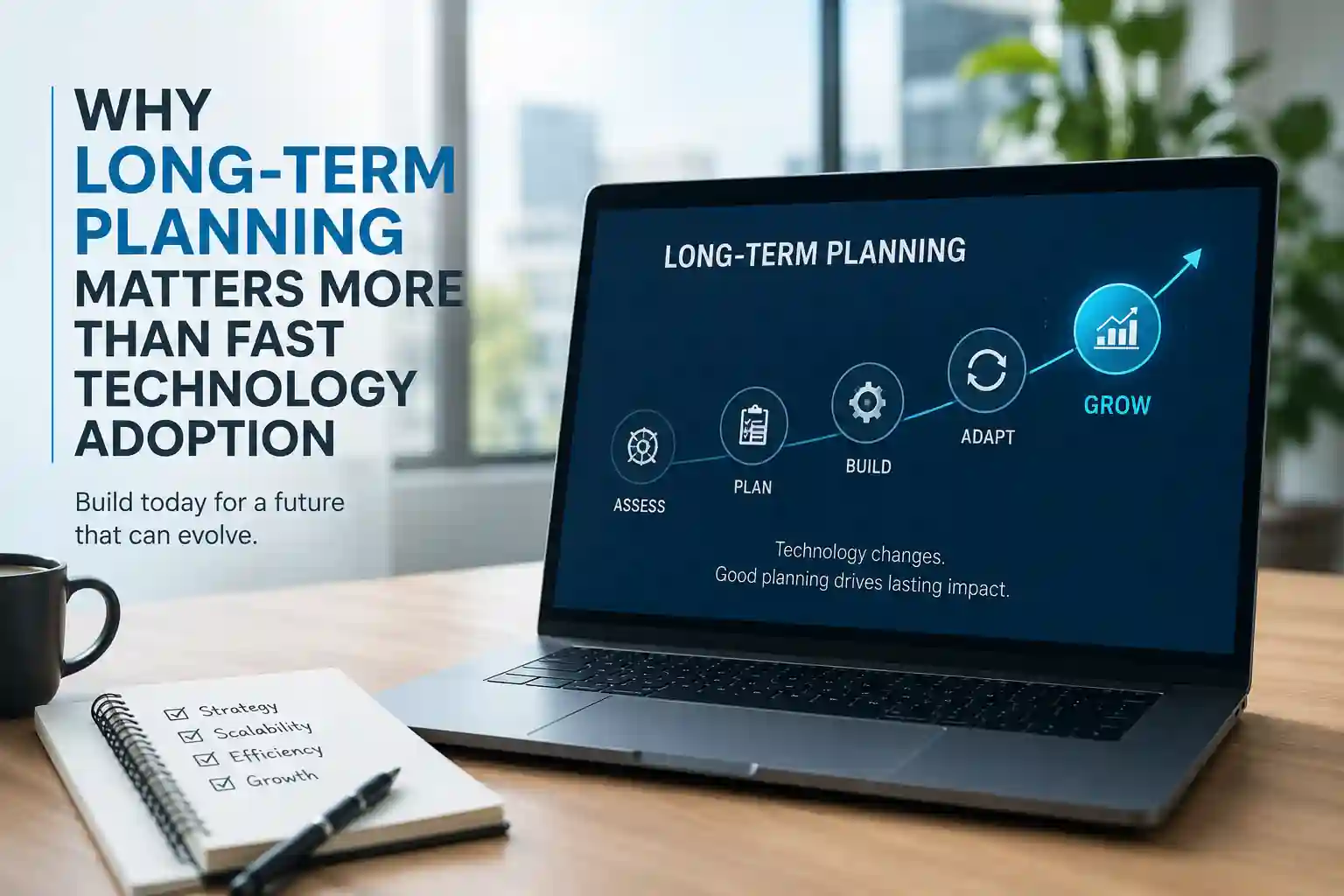
Why Long-Term Planning Matters More Than Fast Technology Adoption
Every few years, a new wave of technology promises to reshape the way organisations operate. Cloud computing, automation, artificial intelligence, and advanced data platforms have all delivered meaningful improvements, but their value depends less on the technology itself than on the decisions surrounding its implementation. Businesses that benefit most tend to treat digital change as a long-term planning exercise rather than a series of isolated upgrades.
Technology projects often begin with immediate operational goals—reducing repetitive work, improving communication, or speeding up customer interactions. Those outcomes matter, but they are only part of a broader picture. Sustainable digital transformation requires organisations to consider how today's decisions will affect future growth, workforce capabilities, and operational resilience.
For businesses evaluating software architecture, automation opportunities, or AI integration, long-term thinking creates a framework that extends beyond the next financial quarter.
Building Systems That Can Adapt Over Time
One of the most common reasons digital initiatives lose momentum is that they are designed around current needs alone. As organisations grow, processes evolve, regulations change, and customer expectations shift. Systems that cannot adapt eventually become barriers instead of assets.
Scalable software architecture, thoughtful data management, and flexible automation all contribute to a technology environment that supports future decision-making rather than limiting it. The emphasis should be on creating systems that remain useful despite changing business conditions.
At Lucid Sequence, discussions around digital transformation frequently emphasise designing technology that can evolve alongside the organisations using it. That perspective reflects a broader industry recognition that successful digital infrastructure is measured over years, not months.
Planning Before Tools
Technology decisions rarely exist in isolation. They intersect with operational planning, financial priorities, workforce development, and organisational goals. When planning happens first, technology choices become easier because each investment serves a clearly defined purpose.
This planning-first approach appears across different areas of business development. For example, organisations discussing marketing systems for small businesses often begin by documenting long-term business objectives before selecting software or implementation methods. The technology becomes one element within a larger strategic framework rather than the starting point itself.
That principle applies equally to internal systems, customer platforms, automation projects, and emerging AI capabilities. Planning creates continuity even as specific technologies continue to evolve.
Businesses that invest time in understanding future operational requirements also reduce the likelihood of replacing systems prematurely. Instead of repeatedly responding to short-term pressures, they establish a more stable foundation for ongoing improvement.
For additional perspectives on digital innovation and technology planning, readers can explore other insights published throughout the Lucid Sequence website.
Technology Ages Quickly, Good Planning Doesn't
Few people can accurately predict which software platforms will dominate five years from now. New capabilities emerge constantly, and market leaders frequently change. What remains remarkably consistent is the importance of deliberate planning.
Organisations with clearly defined objectives are generally better positioned to evaluate new technologies without chasing every trend. They understand what problems need solving, which investments align with long-term priorities, and where flexibility should be preserved.
This mindset also reduces unnecessary complexity. Rather than accumulating disconnected tools over time, businesses can build technology ecosystems that remain coherent as they expand. The result is often lower maintenance, smoother adoption, and fewer disruptive transitions when change becomes necessary.
Digital transformation is ultimately less about adopting the newest technology than about creating conditions where technology continues to support organisational goals long after implementation. While software, platforms, and automation techniques will inevitably evolve, careful planning provides the continuity that allows businesses to adapt with confidence instead of constantly starting over.