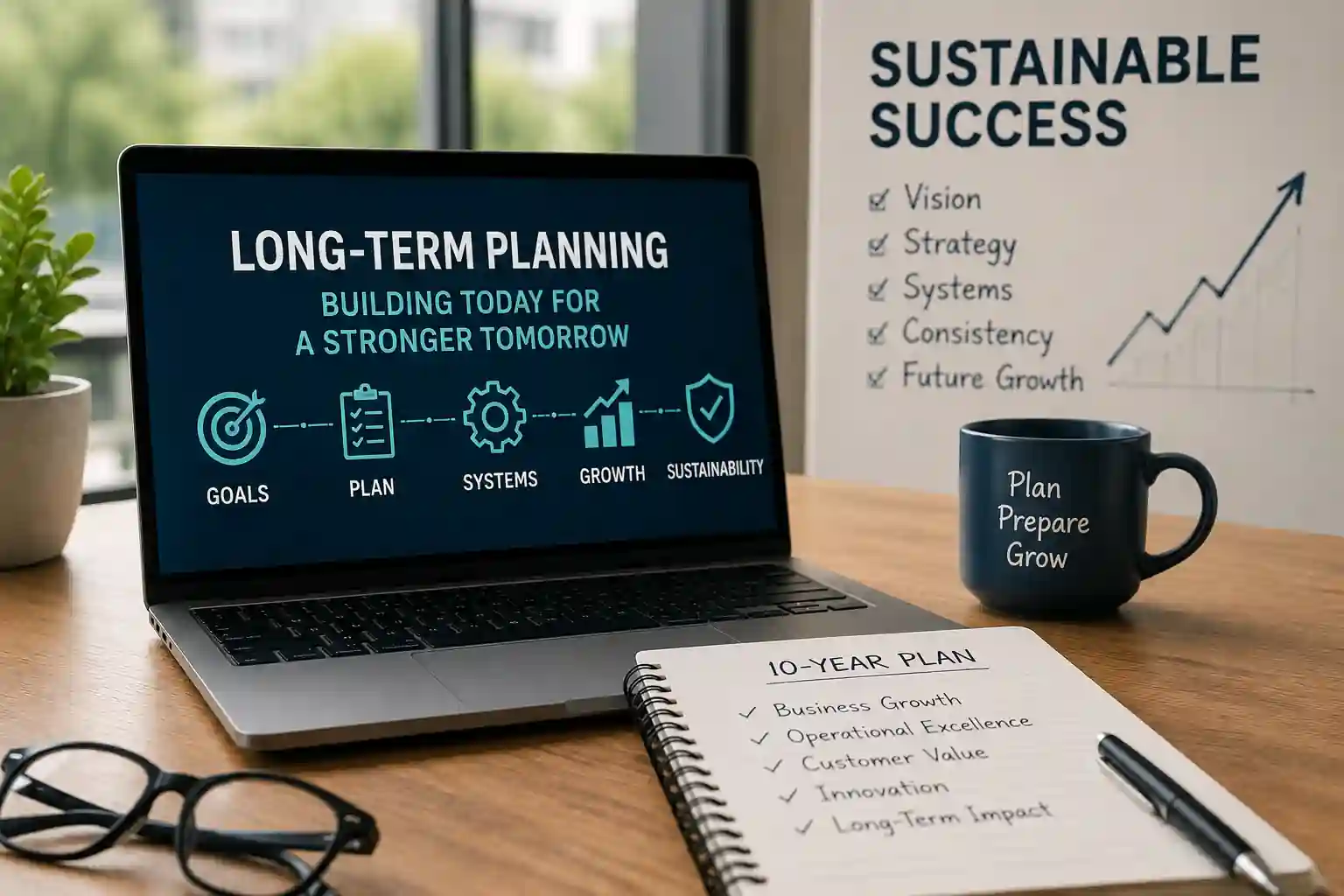
Why Long-Term Planning Matters More Than Rapid Growth for Small Businesses
Business growth is often measured in visible milestones. Revenue increases, expanding teams, new locations, and larger customer bases are easy to identify and celebrate. Yet many business owners eventually discover that growth alone is not always a reliable indicator of long-term success.
What often determines whether a business remains viable over many years is not how quickly it grows, but how deliberately it plans. Long-term planning creates structure around decision-making, helping organisations navigate uncertainty without constantly changing direction. For small and medium-sized enterprises, this discipline can become one of the most valuable assets they possess.
Businesses that endure tend to spend time thinking beyond immediate outcomes. They consider how operational decisions made today may affect performance years into the future. While short-term opportunities will always require attention, sustainable progress usually depends on balancing present demands with future objectives.
The Hidden Cost of Reactive Decision-Making
Many businesses begin by responding to immediate needs. This approach is understandable, particularly in competitive environments where owners must manage multiple responsibilities simultaneously. However, a reactive operating model can become difficult to maintain as complexity increases.
When planning horizons remain short, organisations often find themselves revisiting the same challenges repeatedly. Resources are redirected, priorities shift frequently, and valuable time is spent addressing issues that could have been anticipated earlier.
Long-term planning does not eliminate uncertainty. Markets change, customer expectations evolve, and economic conditions fluctuate. What planning provides is a framework for evaluating decisions against broader objectives rather than immediate pressures alone.
This perspective is frequently discussed within business advisory circles because it supports consistency. Whether the focus is staffing, technology adoption, customer engagement, or operational development, decisions become easier when guided by a clearly defined long-term direction.
For businesses seeking practical guidance on strategic development and digital operations, resources available through Bocledi Digital's service pages illustrate how structured planning can influence technology and business outcomes over time.
Systems Support Plans, Plans Support Systems
Long-term planning becomes significantly more effective when supported by reliable systems. A strategy may establish direction, but systems create the mechanisms required to execute that direction consistently.
This principle is increasingly visible across many sectors. Businesses are paying closer attention to how information is managed, how customer interactions are recorded, and how processes are documented. Rather than relying entirely on individual effort, organisations are seeking ways to build repeatable structures that support continuity.
Within broader discussions about organisational planning, some business communities have explored concepts such as marketing strategy for service businesses as part of wider conversations about aligning operational systems with long-term objectives. The interest is less about specific tactics and more about understanding how structured approaches can contribute to consistency over extended periods.
The underlying lesson extends beyond marketing. Any process that can be documented, measured, and improved over time becomes easier to manage as a business grows.
Endurance Is Rarely Accidental
The businesses that remain relevant for decades rarely arrive there through a series of fortunate events. More often, their longevity reflects thousands of deliberate decisions made with future consequences in mind.
Long-term planning encourages business owners to think beyond immediate results and consider resilience, continuity, and adaptability. It creates space for measured growth while reducing the likelihood of constant operational disruption.
Not every prediction will prove accurate, and not every plan will unfold as expected. Nevertheless, organisations that consistently invest time in understanding where they want to be in five or ten years are generally better positioned to navigate uncertainty than those focused solely on the next quarter.
For small businesses, long-term planning is not simply an administrative exercise. It is a practical discipline that helps transform ambition into sustainable progress, one considered decision at a time.