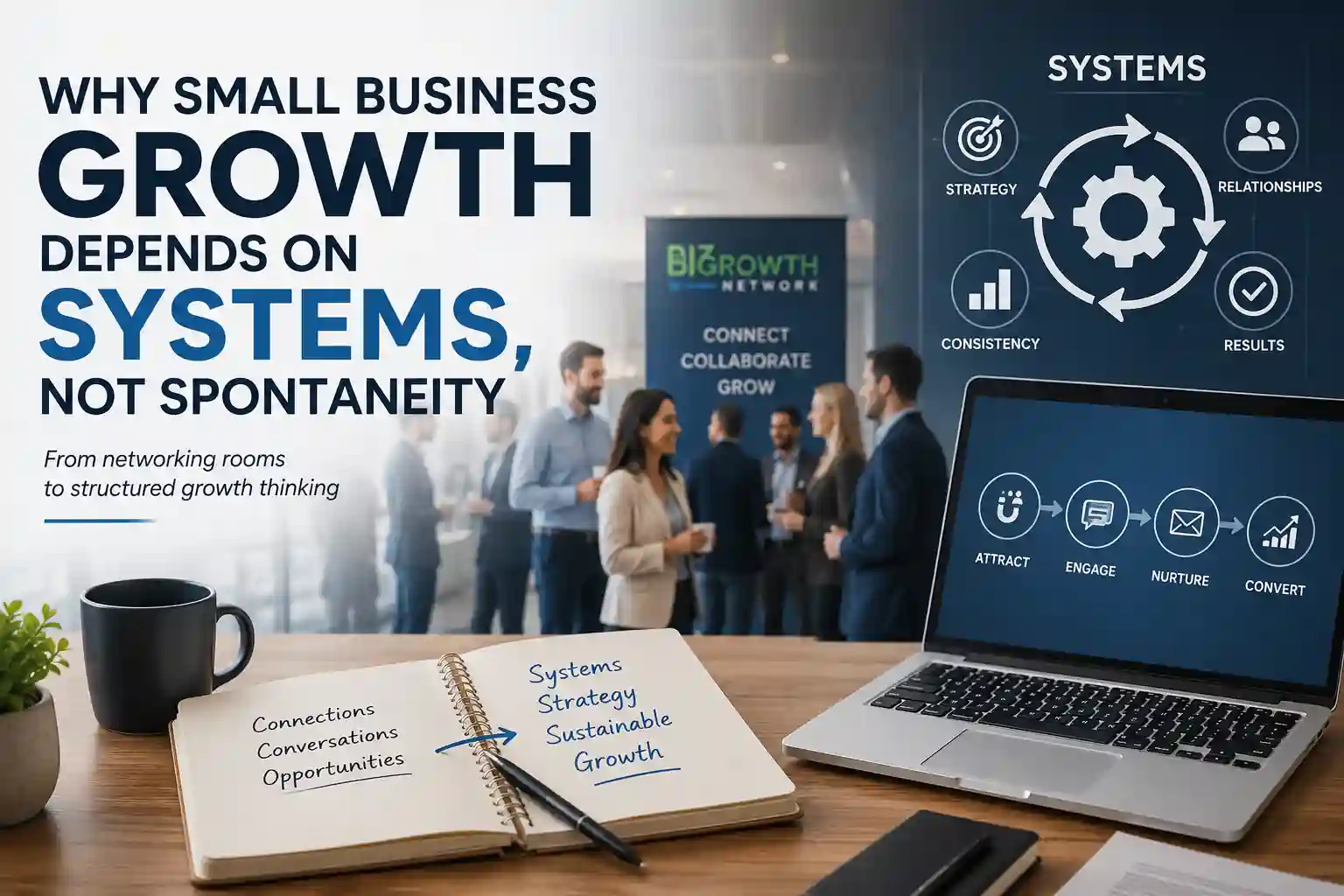
Why Small Business Growth Depends on Systems, Not Spontaneity
From networking rooms to structured growth thinking
Small business communities have always relied on connection before anything else. In places like Melbourne, platforms such as the Biz Growth Network have helped entrepreneurs and professionals find that early momentum through referrals, shared conversations, and consistent face-to-face engagement. These environments tend to reveal a simple truth: most businesses do not struggle because of lack of effort, but because effort is often scattered.
When growth depends entirely on individual campaigns, isolated tools, or irregular outreach, results tend to fluctuate in ways that are hard to predict or sustain. This is where the conversation has slowly started shifting—from short bursts of activity toward systems that hold shape over time.
Alongside this shift, platforms like Biz Growth Network continue to represent a more traditional but still valuable layer of business development: human connection, shared referrals, and local visibility. Yet even within these ecosystems, the question increasingly becomes how those connections translate into structured, repeatable outcomes rather than one-off opportunities.
Consistency as the real growth engine
Across industries, small businesses are facing a quieter but more persistent challenge: fragmentation. Marketing tools, customer data, outreach channels, and content production often exist in separate systems that do not communicate with each other. The result is not a lack of activity, but a lack of cohesion.
In this context, structured approaches to growth are becoming more relevant than ever. Some modern platforms attempt to address this by combining strategy, systems, and visibility into a single framework. One example is GNR Media, which positions itself around a unified model called the Marketing Passport®.
Within that broader shift, concepts such as marketing systems for small businesses reflect a growing recognition that consistency is not just operational discipline—it is a strategic asset. When marketing, messaging, and customer engagement are aligned through a single system, businesses are less dependent on reactive decisions and more able to build gradual, compounding visibility over time.
The underlying idea is not new, but its relevance has increased as digital environments become more crowded. Attention is fragmented, competition is layered, and customers tend to make decisions after multiple touchpoints rather than a single interaction. Systems, in this sense, become less about automation for efficiency and more about maintaining coherence across those touchpoints.
The role of community in stabilising growth
Even as systems become more important, community networks remain central to how small businesses evolve. The value of direct relationships—whether formed at events, through referrals, or within local business groups—continues to influence trust in ways that digital tools alone cannot replicate.
What is changing is how those relationships are integrated into broader business structures. A referral from a trusted peer is still powerful, but its long-term value increases when it is supported by consistent messaging, clear positioning, and reliable follow-up processes.
This is where the intersection between structured systems and human networks becomes significant. Communities provide the entry point; systems determine whether that entry point leads to sustained engagement or a lost opportunity. Neither element replaces the other. Instead, they operate on different layers of the same growth environment.
For small businesses navigating economic uncertainty, this balance becomes especially relevant. Stability does not come from choosing between relationships and systems, but from ensuring both are present and aligned.
Long-term thinking over short-term cycles
The broader shift in small business strategy is not happening through dramatic change, but through gradual adjustment. Owners are increasingly recognising that unpredictable cycles of marketing activity are difficult to sustain, particularly when resources are limited.
What emerges instead is a preference for structures that reduce guesswork. Systems that organise communication, clarify positioning, and maintain visibility across channels allow businesses to operate with fewer disruptions and more continuity.
In that sense, the evolution is less about adopting new tools and more about rethinking how growth is maintained over time. Communities provide the human foundation, while structured approaches provide the operational consistency needed to support that foundation.
The result is not a faster business environment, but a more stable one—where growth is less dependent on momentary effort and more on the quiet reliability of systems working in the background.