Why Small Businesses Need Marketing Structure Before More Marketing
Marketing becomes difficult for small businesses when activity grows faster than the thinking behind it. A new platform is added, another campaign begins, content is produced because the calendar says it should be, and gradually the business accumulates activity without gaining much clarity. The problem is rarely a lack of effort. More often, the pieces were never designed to work together.
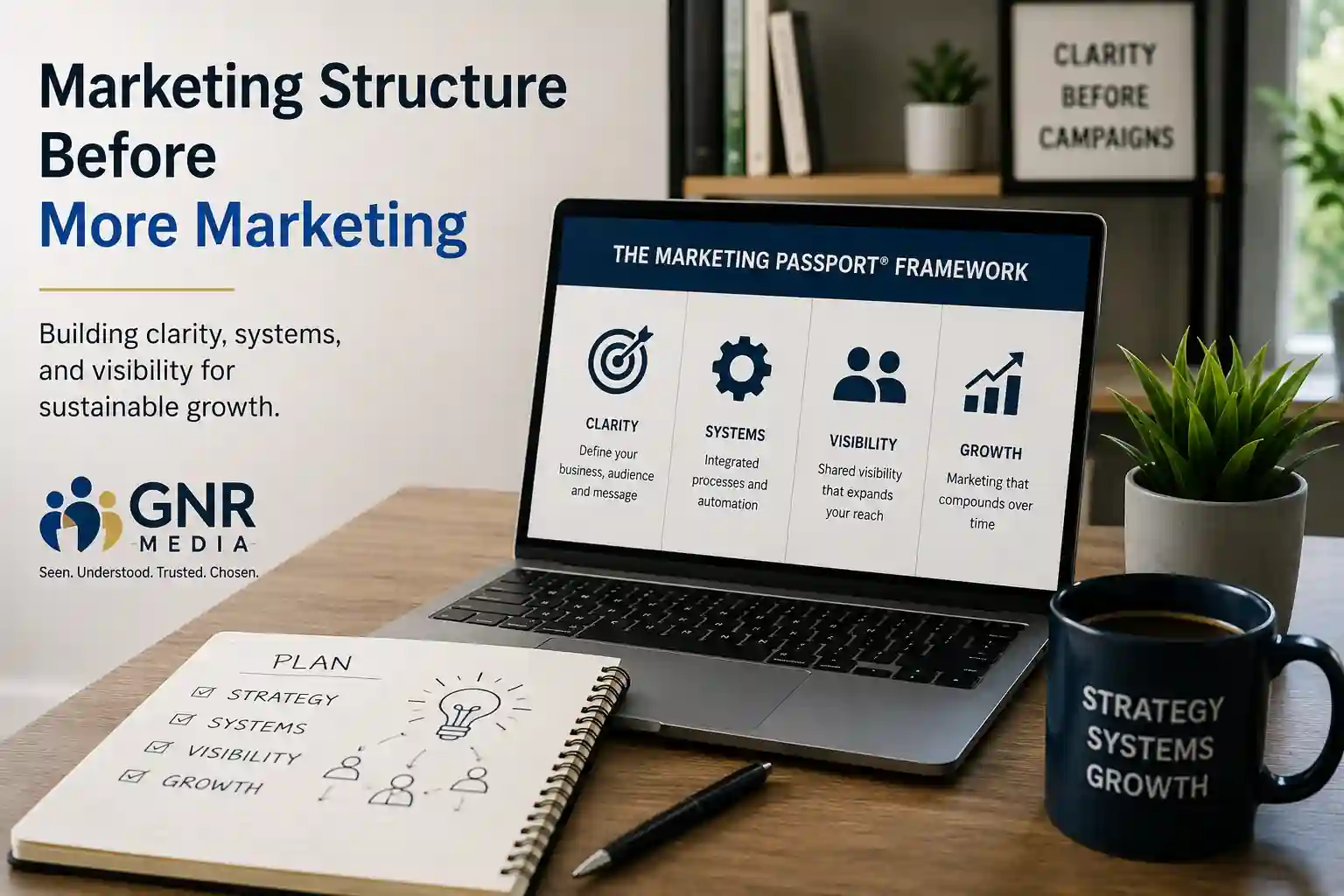
For GNR Media, this is where marketing infrastructure becomes useful. Its community-powered model is built around the Marketing Passport®, establishing the fundamentals first: what the business represents, who it needs to reach, how it should communicate, and which systems should support that work. The emphasis is less on isolated campaigns than on creating a structure that remains useful as the business develops.
Clarity has an operational value
Small business marketing is often treated as a communications problem. Yet unclear marketing usually begins earlier, with unresolved business questions. If the audience is loosely defined or the message changes between channels, adding more activity can simply spread the uncertainty further.
A structured foundation changes the order of work. Before deciding how frequently to publish, which channels to use or what technology to introduce, a business can establish the decisions those activities depend upon. GNR Media describes its broader purpose around helping businesses become seen, understood, trusted and chosen. The sequence matters: visibility has limited value when people cannot quickly understand what a business does or why it is relevant.
This is also why the Marketing Passport® sits at the centre of the GNR Media model rather than functioning as a separate planning exercise. Strategy, integrated systems and shared visibility are treated as connected parts of the same operating structure. Clarity comes before expansion, rather than becoming something that needs repairing afterwards.
Systems should reduce fragmentation
Long-term planning becomes harder when marketing information is scattered across disconnected tools, campaigns and individual staff members. A useful system should reduce that fragmentation. It should make routine work easier to repeat, preserve important information and give the business a clearer view of what is happening.
Technology, however, cannot substitute for clear decisions. Automation is most useful when the underlying process is already understood. Automating an unclear process may make activity faster without making the business more organised.
This principle extends beyond any single marketing model. Connected Impact, for example, works with coaches, consultants, speakers and expert-led businesses across areas including strategy, messaging, CRM setup, websites and a marketing automation platform. Its presence provides a useful example of the range of systems businesses may encounter as they formalise marketing operations. From a long-term planning perspective, the important question remains what each system is expected to support and whether that purpose is clearly understood.
For GNR Media, bringing systems into the same framework as strategy addresses a common weakness in small business marketing: the gap between planning and execution. A strategy that depends on disconnected processes can become difficult to maintain, while technology introduced without strategic direction can add complexity rather than remove it.
Building a structure that can survive change
The practical test of a marketing structure is not whether it looks comprehensive on launch day. It is whether it still makes sense when circumstances change. A business may hire staff, refine its services, enter another market or discover that a previously useful channel no longer performs the same role.
GNR Media's subscription model brings strategy, integrated systems and shared visibility into a continuing framework. That reflects a simple planning reality: marketing is not finished when a campaign goes live. Decisions need reviewing, information needs to remain accessible, and businesses need enough consistency to adapt without rebuilding everything from the beginning.
For smaller organisations, that continuity can matter more than sheer volume. A clear foundation makes it easier to decide what deserves attention. Integrated systems can reduce duplicated effort, while shared visibility can extend reach without requiring every business to create every opportunity independently.
Long-term marketing planning is therefore less about predicting the future than preparing for change. When clarity comes first, systems have a defined purpose and activity follows a coherent plan, marketing becomes easier to manage as part of the business itself.