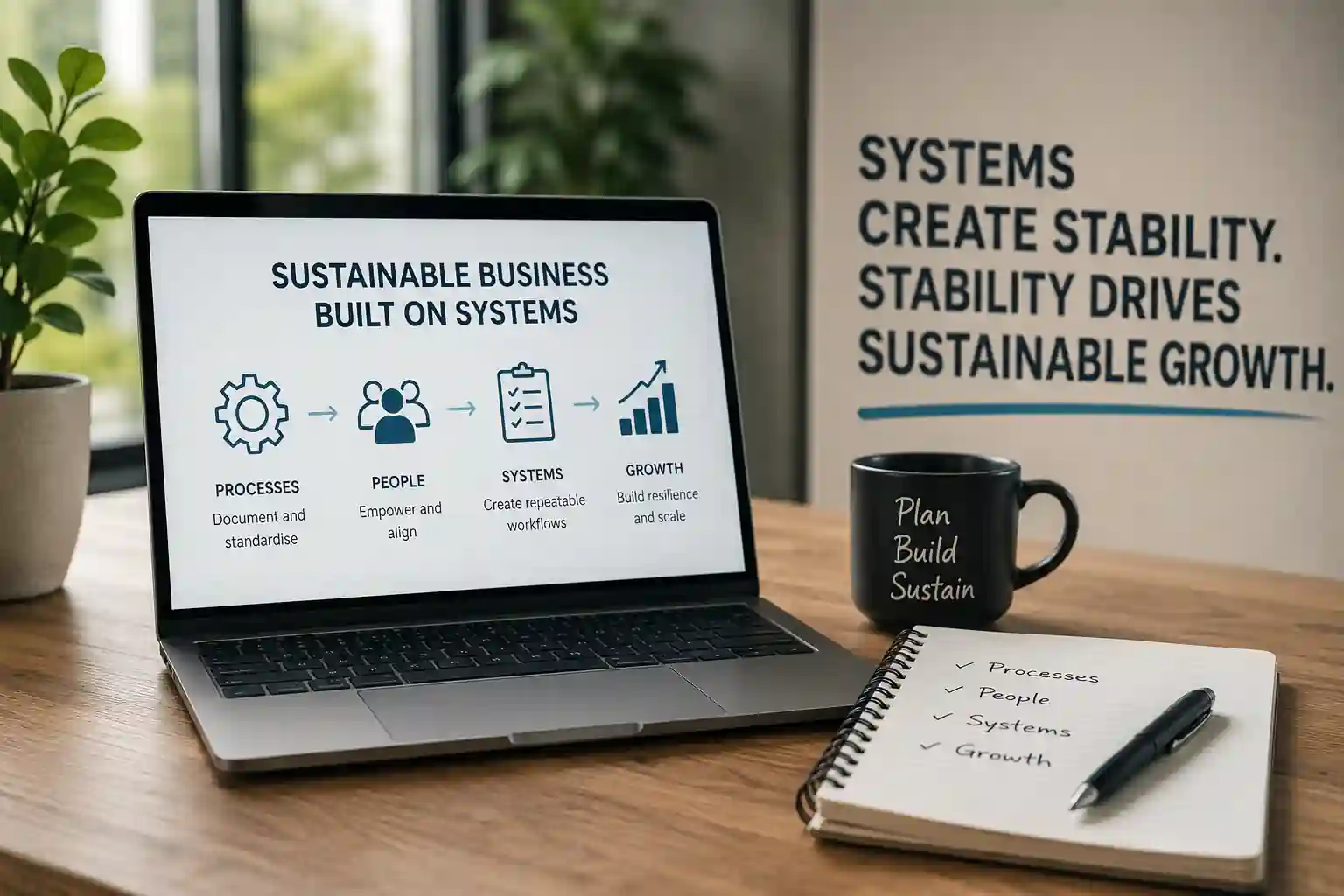
Why Sustainable Small Businesses Depend on Systems More Than Momentum
Many small businesses begin with energy, determination, and a founder willing to do whatever is necessary to keep things moving. In the early years, momentum often feels like the most important asset. A strong network, a few loyal clients, and consistent effort can create steady progress without extensive infrastructure.
Over time, however, momentum becomes difficult to sustain on its own. As customer expectations increase and operations become more complex, the businesses that remain stable are often those that have quietly invested in systems. Sustainability is rarely the result of a single successful period. More often, it comes from creating repeatable ways of working that continue to function when conditions become less predictable.
The Difference Between Activity and Stability
Many owners spend years refining their products or services but give less attention to the processes that support daily operations. This can create a situation where growth depends heavily on individual effort rather than organisational resilience.
When key activities exist only in someone's memory, businesses become vulnerable to disruption. Staff turnover, unexpected absences, market fluctuations, and changing customer behaviour can quickly expose gaps that were previously hidden by constant activity.
By contrast, sustainable businesses tend to document processes, define responsibilities, and establish systems that allow knowledge to remain within the organisation rather than with a single individual. This creates continuity and makes long-term planning more realistic.
Acorn Group's insights and advisory resources available through its internal knowledge base can be useful examples of how business owners approach operational consistency as part of broader growth planning.
Building Resilience Through Repeatable Processes
Sustainability is often discussed in environmental or financial terms, but operational sustainability deserves equal attention. Businesses that rely on repeatable systems can adapt more effectively because they spend less time rebuilding processes from scratch.
This principle extends across customer service, administration, recruitment, sales, and communication. Consistency does not eliminate challenges, but it reduces the amount of uncertainty involved in responding to them.
Marketing presents a particularly interesting example. Many businesses experience periods of strong visibility followed by long stretches of inconsistency. Rather than relying exclusively on short-term campaigns, some organisations have begun exploring structured approaches that connect communication, planning, and measurement. Discussions around marketing systems for small businesses have emerged within this broader conversation about sustainability, reflecting a growing interest in creating processes that continue to function beyond individual campaigns or personnel changes.
The underlying lesson is not specific to marketing. It applies equally to every area where businesses seek dependable outcomes from limited resources.
Sustainable Growth Is Often Quiet
There is a tendency to associate business success with rapid expansion, visible milestones, or major announcements. Yet many of the organisations that endure for decades grow through quieter decisions made consistently over time.
They refine workflows. They improve documentation. They create training processes. They establish routines that allow the business to operate effectively even when circumstances change.
These actions rarely attract attention, but they contribute significantly to long-term sustainability. Small improvements, repeated over many years, often have a greater impact than occasional bursts of activity.
For business owners, this perspective can be valuable because it shifts the focus away from chasing constant momentum and toward building foundations that support stability. Sustainable businesses are not necessarily the fastest growing at any given moment. They are often the ones that have created systems capable of carrying them through periods of uncertainty while preserving the capacity to grow when opportunities emerge.